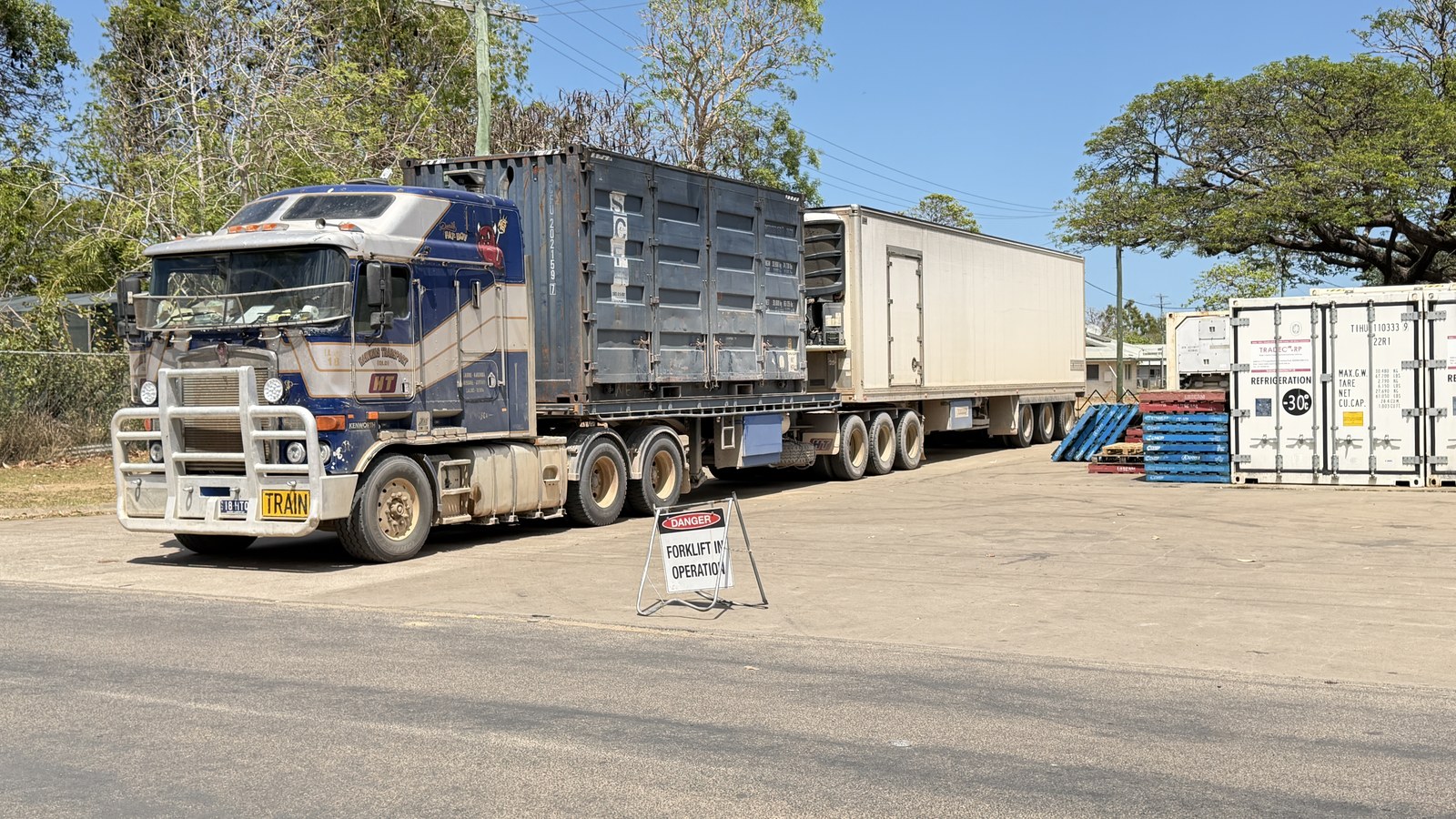
The temporary grounding of Hawkins Transport exposed a question that goes well beyond one operator: when a commercial freight service into a remote community suddenly disappears, who is responsible for making sure essential supplies keep moving?
Kowanyama Aboriginal Shire Council says that responsibility should not simply fall back on small, under-resourced remote councils.
The issue emerged after the National Heavy Vehicle Regulator issued prohibition notices to Hawkins Transport, temporarily preventing the company from operating before the notices were subsequently lifted.
Hawkins is one of three freight companies servicing Kowanyama, alongside Tuxworth & Woods and Geoffrey’s Transport, according to Kowanyama Aboriginal Shire Council interim chief executive Mark Crawley.
Crawley told WWTG the loss of any of those services could affect the community.
“Shutting down one, or all, of these transport providers has an impact on the community. Bringing groceries to the store is considered essential for our very remote community.”
Crawley said he was not aware of Council receiving formal notification from the regulator about the Hawkins action.
Three carriers does not necessarily mean instant spare capacity
Having three freight companies serving a community might appear to provide redundancy. But the important question is whether the remaining operators have the trucks, drivers, equipment, depot capacity and schedules required to absorb another carrier’s freight at short notice.
Crawley said it was unclear whether Kowanyama’s other freight providers could immediately increase their services if one became unavailable.
Council does undertake preparedness work with local stores, particularly ahead of the prolonged road closures that can occur during the wet season. But Crawley drew a distinction between that role and responsibility for replacing a commercial freight provider.
“Council is not responsible for freight into the community.”
Queensland already has established arrangements for communities isolated by disasters such as flooding. The Queensland Reconstruction Authority told WWTG that Local Disaster Management Groups, supported by Queensland Police and District Disaster Management Groups, play an important role when communities are isolated during disasters. Established resupply operations can provide food, medical supplies and other essentials until access is restored.
The Hawkins situation presented a different problem: the road itself did not have to disappear. Instead, commercial freight capacity could disappear while the transport network remained open.
Queensland has resilience arrangements — but commercial responsibility remains divided
The Department of State Development, Infrastructure and Planning told WWTG Queensland’s resilience system involves government agencies, industry and governance arrangements. DSDIP leads the Economic Functional Recovery and Resilience Group, which brings government and industry together on economic resilience and supply-chain issues.
The department said it works with major grocers, logistics providers and remote-store operators on preparedness and supply-chain resilience, including pre-positioning essential goods. It is also working with other agencies on alternative freight modes into Far North Queensland because road and rail networks are regularly disrupted during the wet season.
DSDIP told WWTG that TMR is responsible for the effective operation of the transport network and can liaise with regulators, while supermarkets and remote-store operators remain responsible for the commercial arrangements used to transport goods to their stores.
That leaves a grey area when the infrastructure is available but a significant commercial carrier suddenly is not.
TMR monitored the Hawkins disruption
Transport and Main Roads confirmed to WWTG that it was aware of the Hawkins prohibition notices.
A TMR spokesperson said the department engaged with government and industry during the disruption to understand and monitor the effect on freight movements and alternative freight arrangements for affected communities.
TMR said improving freight-system resilience was a key focus, particularly in remote and regional Queensland where communities can be affected by severe weather, infrastructure failures and other supply-chain disruptions.
What TMR’s response does not establish is a single automatic mechanism under which another agency assumes responsibility for replacing lost commercial freight capacity when the disruption is not a declared disaster.
“It should not be left to under-resourced local governments”
Crawley said that when an external decision disrupts a freight service, residents will naturally turn to their council. But that does not mean councils have the resources or authority to solve the problem.
“If the regulator is to close down a freight company, for whatever reason, it should not be left to the under resourced local governments in rural and remote areas to sort out freight services for the community.”
He said the freight consequences should be considered when decisions affecting transport capacity are made.
NHVR says freight consequences were considered
The NHVR has previously told WWTG that the Hawkins prohibition notices were issued because of identified safety and compliance concerns.
When the notices were lifted, NHVR Executive Director Statutory Compliance Paul Alsbury said the regulator had considered both the identified safety risks and the importance of reliable freight services to affected communities.
The regulator’s published guidance says prohibition notices are intended for an activity involving an immediate or imminent safety risk, where prohibiting the activity is the most effective and efficient way of ensuring safety in the circumstances.
The regulator has to deal with the safety risk. The unanswered policy question is what happens to the community if exercising that power removes a substantial part of its freight capacity.
What WWTG could not establish: Council could not confirm that the temporary Hawkins disruption caused cancelled or delayed deliveries, or shortages of groceries or other essential supplies. Crawley also cautioned that he could not confirm the operating arrangement behind a Hawkins-branded truck later seen unloading in the community. This report therefore examines the resilience issue exposed by the disruption rather than attributing any specific shortage to it.
Disaster planning versus freight continuity
Queensland clearly has mature arrangements for natural disasters and isolated communities. It also has agencies working on economic resilience, supply-chain preparedness and transport-network continuity.
The Hawkins episode suggests there is another scenario worth examining: a community remains physically accessible, but one of the commercial businesses required to get essential goods there suddenly cannot operate.
The broader question for Queensland is whether the consequences for essential freight should trigger a defined notification and continuity process before a remote community discovers the weakness in its supply chain the hard way.
Primary sources
- Kowanyama Aboriginal Shire Council — Mark Crawley, Interim CEO (response to WWTG)
- Queensland Reconstruction Authority — Economic Functional Recovery and Resilience Group
- Department of State Development, Infrastructure and Planning (response to WWTG)
- Department of Transport and Main Roads (response to WWTG)
- National Heavy Vehicle Regulator — prohibition notice guidance