What should a transport business do when its records conflict?
Short answer
Preserve the originals, investigate the discrepancy and document the explanation and any lawful correction. Do not rewrite records simply to make them agree.
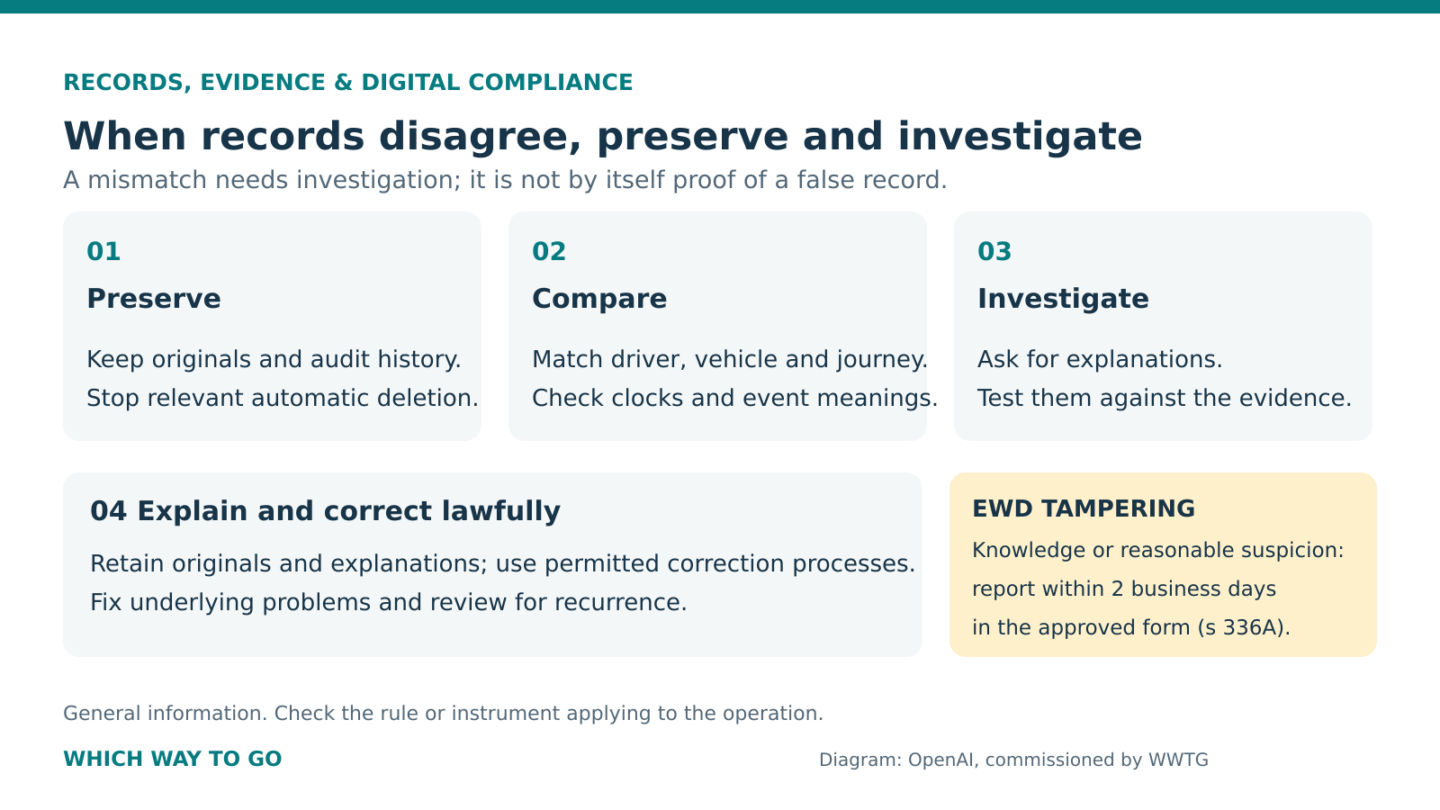
Plain English
A diary, GPS log, delivery docket and timesheet can describe different things. One may record vehicle movement, another a delivery timestamp and another paid hours. A difference needs investigation; it is not, by itself, proof of a false record.
The NHVR has used diary, fuel, GPS and vehicle-sighting evidence together in investigations. Businesses should therefore consider whether their records tell a coherent, explainable account of the operation.
HVNL offences address false or misleading work records and interference with records. In particular, s 329 prohibits changing a work record known, or reasonably expected to be known, to be correct. Correction must follow the rules of the relevant diary or system.
These requirements apply in HVNL-participating jurisdictions: ACT, NSW, Queensland, South Australia, Tasmania and Victoria. WA and NT have separate requirements; check each part of a cross-border journey.
What this means operationally
The following is a practical investigation method:
- Preserve the original records and available audit history.
- Match the driver, vehicle, journey and relevant dates.
- Check time zones, clock settings, driver logins and what each event actually measures.
- Ask the people involved for an explanation and test it against the evidence.
- Record what is established, what remains uncertain and the corrective action.
- Fix any underlying scheduling, training or system problem and review whether it recurs.
Keep an explanation alongside the original record instead of concealing the original. For electronic records, use the system’s authorised correction process and preserve its audit trail.
If a fatigue record keeper knows or reasonably suspects an electronic work diary has been tampered with, s 336A requires a report to the NHVR within two business days in the approved form. An ordinary discrepancy is not automatically tampering, but a genuine suspicion should not be ignored.
General information, not legal advice. Check applicable law and instruments for the actual operation. Seek advice for significant enforcement or disputed evidence issues.
Who it applies to
Transport operators and fatigue record keepers in HVNL-participating jurisdictions.
Example
GPS movement appears during recorded rest. Check who was driving, whether the correct vehicle and driver were matched and whether the clock settings agree. Investigate before deciding the cause; never manufacture a convenient explanation.
Exceptions and traps
A neat set of matching records can still be wrong if staff altered them to conceal what happened.
Legal foundation
HVNL ss 325, 329, 335–336A and 341.
Sources & primary documents
- www.legislation.qld.gov.au/view/whole/html/inforce/current/act-2012-hvnlq
- www.nhvr.gov.au/news/2023/11/08/the-nhvr-has-taken-action-against-a-company-after-discovering-systemic-fatigue-management-and-other
- www.nhvr.gov.au/files/media/document/251/202512-0704-national-driver-work-diary.pdf
WWTG verification: Queensland Legislation (published law), NHVR (published guidance)
Frequently asked questions
Does GPS automatically override a diary?
No. Establish what each record shows and assess the evidence together.
Can an error be corrected?
Use the permitted process for that record or system and retain an explanation.
Must every mismatch be reported as tampering?
No. The specific reporting obligation concerns knowledge or reasonable suspicion of EWD tampering.