How long must work, maintenance, mass and journey records be retained?
Short answer
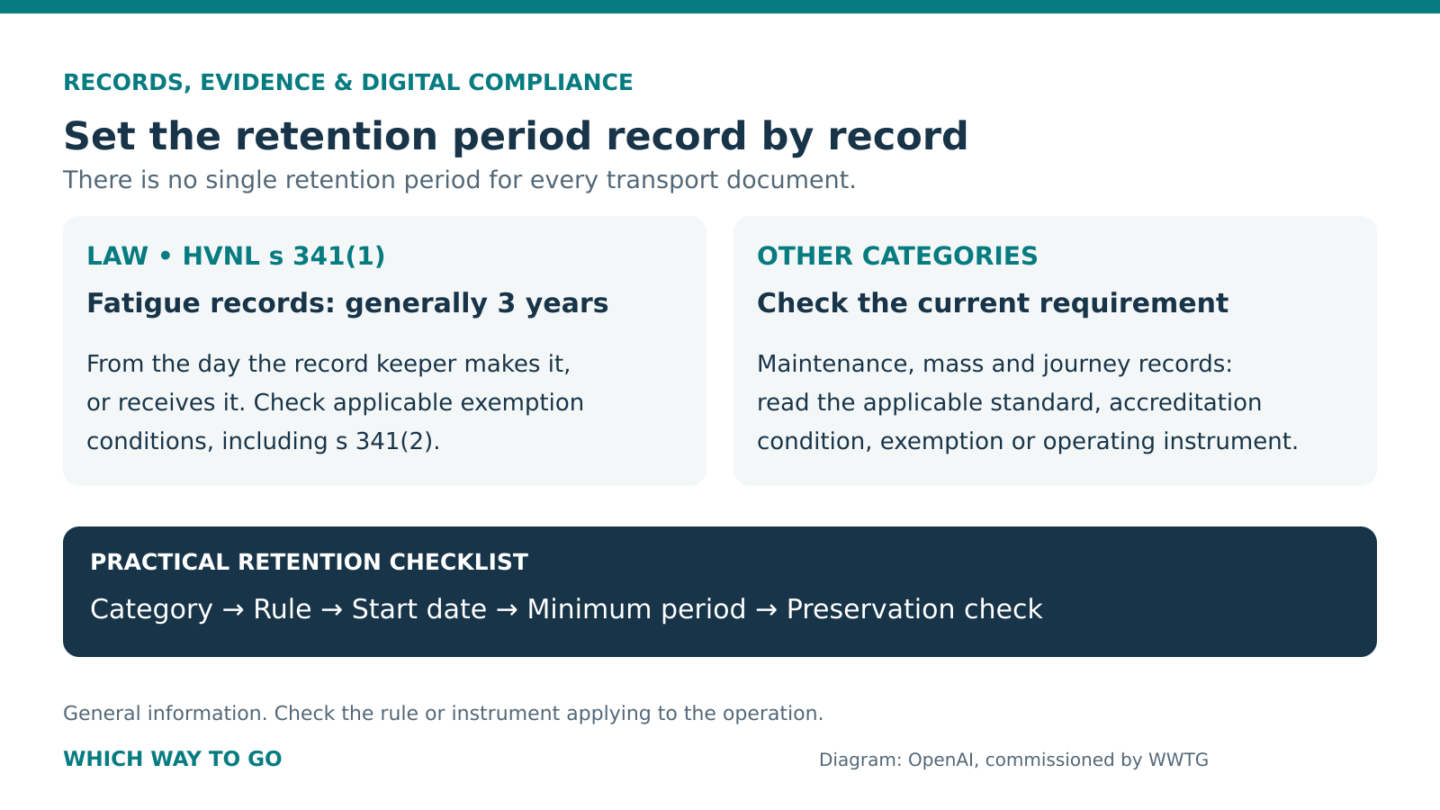
There is no single period for every heavy-vehicle record. For the fatigue records covered by HVNL s 341(1), the record keeper must generally retain them for three years from making or receiving them. Other records need their own rule or condition checked.
Plain English
The statutory starting point matters. Under s 341, a record made by the record keeper is retained from the day it is made; another record is retained from the day it is received. Do not automatically calculate every deletion date from the journey date.
Records covered by fatigue exemptions need the exemption checked as well: s 341(2) allows a shorter period where the relevant exemption condition specifies one.
Record storage must also preserve readability, intelligibility and usefulness as evidence. A retained file that cannot be opened does not solve the problem.
For maintenance, mass and journey records, check the current scheme standards, accreditation conditions and applicable operating instruments. Legacy NHVAS mass and maintenance guides state a minimum three-year audit period; that should not be presented as a universal rule for every operator or as a substitute for checking current HVA/ACA requirements and transition arrangements.
These requirements apply in HVNL-participating jurisdictions: ACT, NSW, Queensland, South Australia, Tasmania and Victoria. WA and NT have separate requirements; check each part of a cross-border journey.
What this means operationally
Use a retention schedule rather than a single “delete after three years” setting. As a practical recommendation, record the category, source of the requirement, start date, minimum period and any reason to preserve it longer.
Employment, tax, insurance, contractual and other requirements may apply separately. Suspend routine deletion of relevant material when an incident, dispute or investigation requires preservation; obtain advice on the scope and duration.
General information, not legal advice. Check applicable law and instruments for the actual operation. Seek advice for significant enforcement or disputed evidence issues.
Who it applies to
Transport operators and fatigue record keepers in HVNL-participating jurisdictions.
Example
Before changing a telematics provider, check which records must remain accessible and export them in a usable format. A cancelled subscription can otherwise leave the business unable to retrieve its history.
Exceptions and traps
The period for carrying a document in the vehicle is different from the period for retaining the business record.
Legal foundation
HVNL s 341; applicable exemptions, standards and conditions.
Sources & primary documents
- www.legislation.qld.gov.au/view/whole/html/inforce/current/act-2012-hvnlq
- www.nhvr.gov.au/safety-accreditation-compliance/fatigue-management/record-keeping-requirements
- www.nhvr.gov.au/files/202106-1213-nhvas-maintenance-management-accreditation-guide.pdf
- www.nhvr.gov.au/files/202102-1214-nhvas-mass-management-accreditation-guide.pdf
WWTG verification: Queensland Legislation (published law), NHVR (published guidance)
Frequently asked questions
Is three years the rule for everything?
No. Match each category to its applicable requirement.
Can records be electronic?
Fatigue records must meet the legal storage and evidentiary requirements; electronic storage must preserve those qualities.
Can we delete when the minimum expires?
First check other obligations and any need to preserve relevant evidence.