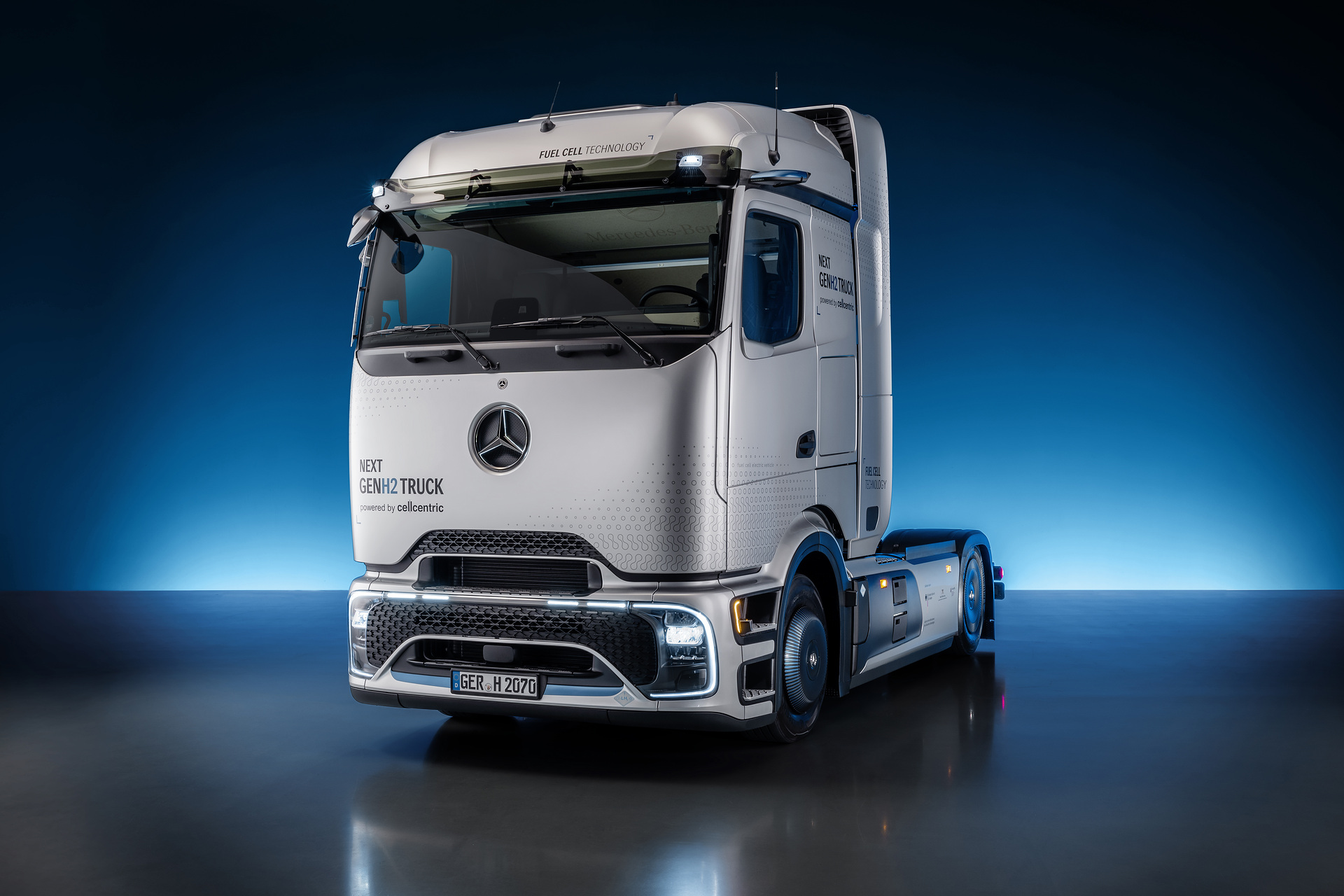
Mercedes-Benz Trucks has brought its NextGenH2 Truck to IAA Transportation 2026 as Daimler Truck prepares to put around 100 liquid-hydrogen fuel-cell trucks into customer operations from the end of 2026.
The headline number is range: Daimler says the truck can travel well over 1,000 kilometres on one filling. But the more significant engineering choice is the fuel itself. Instead of storing compressed gaseous hydrogen, the NextGenH2 carries cryogenic liquid hydrogen, which has greater energy density by volume and is intended to make long-haul range possible without giving up as much chassis space.
How the truck works
The NextGenH2 uses the cellcentric BZA150 fuel-cell system to convert hydrogen into electricity. That electricity powers the electric drivetrain, so this is still an electric-drive truck — the fuel cell is effectively the onboard electricity generator.
Daimler has also deliberately shared production components with the battery-electric eActros 600. That matters commercially because hydrogen does not have to become an entirely separate vehicle architecture: common components can reduce complexity in manufacturing, service and parts support.
Liquid hydrogen brings its own challenge. Hydrogen must be stored at extremely low temperature, requiring insulated cryogenic tanks and a dedicated production, transport and refuelling chain. A long vehicle range is therefore only useful where that fuel infrastructure exists.
Why 100 customer trucks matter
This is not simply another concept vehicle on a show stand. Daimler plans a small series of around 100 trucks for customer operation, with logistics company Dachser among the first users. That moves the technology into the stage where fleets can test utilisation, refuelling, reliability, maintenance and operating cost under real freight conditions.
It is still not mass production. The trial should instead be read as a commercial-scale test of whether liquid hydrogen can solve jobs that battery-electric trucks may find difficult.
Why it matters in Australia
Australia has exactly the sort of operating conditions that keep the hydrogen argument alive: very long freight corridors, high utilisation, heavy combinations and locations where a truck may need to cover large distances before returning to base.
But vehicle range alone does not establish a business case. An Australian hydrogen-freight network would need reliable low-cost hydrogen production, liquefaction, transport or local production, storage and truck-scale refuelling at the places freight actually moves through. Fuel price and station utilisation would be as important as the truck itself.
That makes the useful comparison less about “hydrogen versus batteries” in the abstract and more about particular freight tasks: which routes can support high-power charging, which can support hydrogen refuelling, how much payload each system gives up, how quickly vehicles can refuel or recharge, and what the total cost per loaded kilometre becomes.
The NextGenH2 program is European. Daimler Truck has not announced Australian availability for the vehicle.
Primary source: Daimler Truck, IAA Transportation 2026 material.