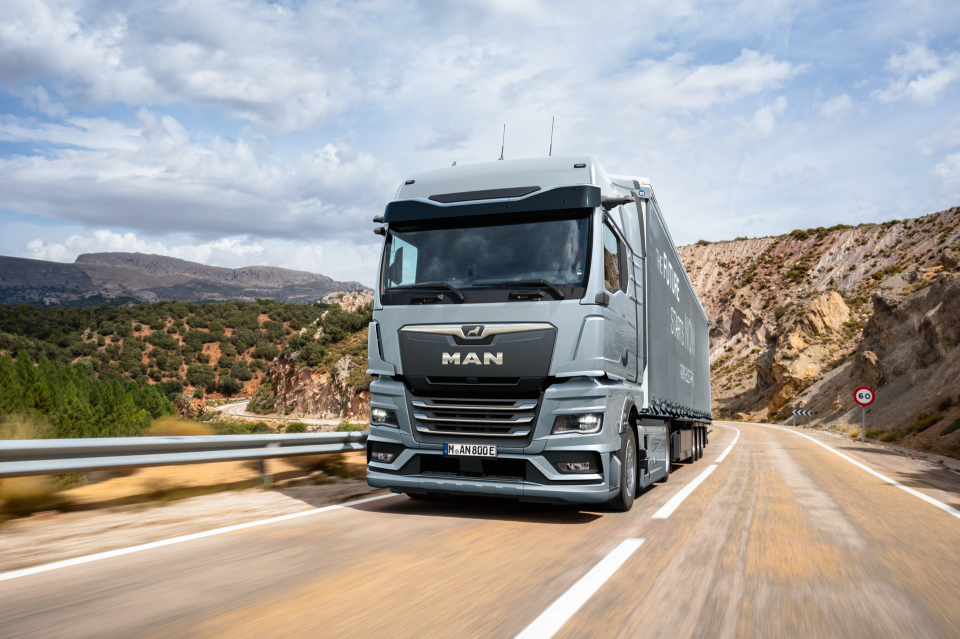
MAN has used IAA Transportation 2026 to push its battery-electric eTGX further into genuine long-haul territory, with the longest-range 6×2 version claimed to travel up to 720 kilometres without intermediate charging.
The figure comes from adding a seventh battery pack. MAN says the 6×2 can carry up to 644 kWh of installed battery capacity, while the latest battery generation provides about 10 per cent more usable energy than before. The 4×2 eTGX is rated at up to 660 km.
The technical change is more than another battery
Range is only part of the engineering story. MAN says it has also improved aerodynamics and energy recuperation. In the 4×2 configuration, the manufacturer says payload with a standard trailer can reach about 25 tonnes — important because battery mass can otherwise eat directly into the freight a truck can legally carry.
The other major development is charging power. MAN has been fitting trucks for Megawatt Charging System (MCS) capability since July 2026. At IAA, MAN, Daimler Truck and Scania demonstrated interoperable megawatt charging with infrastructure operator Milence. The IAA says trucks in the demonstration could reach 80 per cent or full charge within 30–45 minute driver rest breaks.
MAN says an MCS-equipped eTGX can move from 20 to 80 per cent charge in roughly 30 minutes. That changes the operational question. A 720 km headline range does not mean an electric truck can simply replace a diesel truck on every route; it means charging location, grid capacity and whether a high-power charge can be fitted into the working day become at least as important as battery range.
Why it matters in Australia
Australia has long freight corridors, high combination masses and sparse infrastructure outside major centres. A European 720 km maximum therefore should not be read as an Australian real-world range figure. Gross combination mass, speed, gradients, weather, auxiliary loads and trailer configuration all affect energy consumption.
But the direction of travel matters. If a truck can cover several hundred kilometres, then recover a substantial part of its battery during a normal rest period, the constraint begins shifting from the vehicle to the electricity network and charging sites.
That leaves practical Australian questions: where would megawatt chargers sit on major freight corridors, what connection capacity would each site require, how many trucks could charge simultaneously, what would demand charges do to operating cost, and how would electric combinations perform at Australian masses?
MAN says the new-generation eTGX is due to go on sale in Europe in 2027. No Australian availability has been announced.
Primary sources: MAN Truck & Bus IAA Transportation 2026 material; IAA Transportation 2026 MCS demonstration material.