What are Supervisory Intervention Orders, enforceable undertakings and injunctions?
Short answer
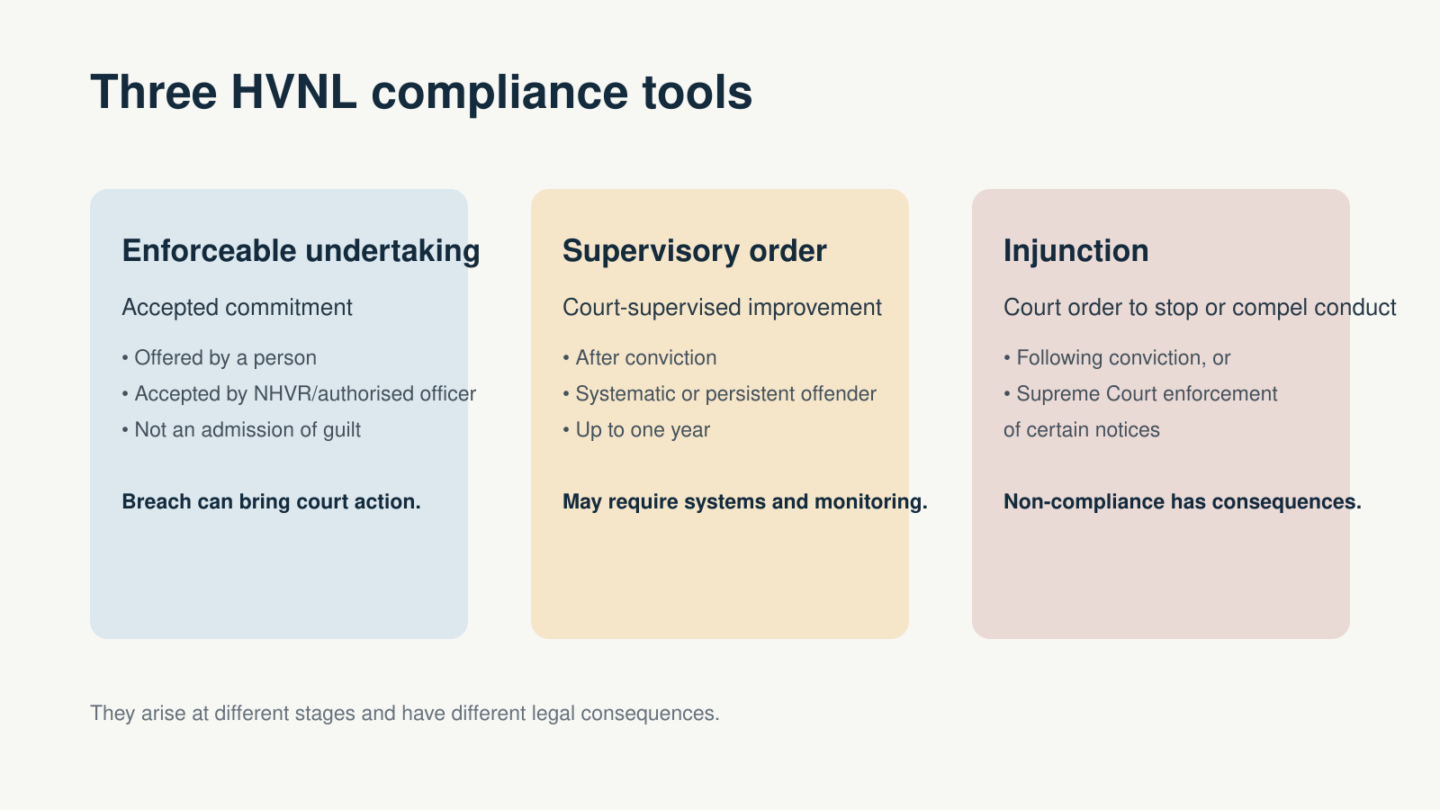
They are different compliance tools: an enforceable undertaking is an accepted commitment, while a Supervisory Intervention Order and an injunction are court orders.
Plain English
An enforceable undertaking is a formal commitment offered by a person and accepted by the NHVR or an appropriately authorised officer in connection with an alleged or actual HVNL contravention. It cannot be demanded as an alternative to prosecution. It must be in the approved form and can only be accepted where the decision-maker reasonably believes it will ensure compliance. It is unavailable for a contravention or alleged contravention of HVNL s 26F. Making an undertaking is not an admission of guilt. If it is completed, proceedings cannot be taken for the contravention covered by it. If it is breached, a court or tribunal can order compliance or discharge it, impose penalties and costs, and proceedings concerning the original contravention may still be taken.
What this means operationally
A Supervisory Intervention Order is different. A court can impose one after conviction where the person is considered a systematic or persistent offender. It can last up to one year and may require staff or management changes, training and supervision, expert compliance advice, monitoring equipment, new safety systems, reporting or an independent compliance monitor. An injunction is also a court order. Following conviction, a court can order a person to cease contravening the HVNL. The Supreme Court can also issue an injunction compelling compliance with—or restraining conduct contrary to—an improvement or prohibition notice.
Who it applies to
Operators, businesses and Chain of Responsibility parties facing serious or repeated HVNL compliance action.
Example
In a published NHVR court outcome, a company was ordered to provide approved training, introduce electronic work diaries and report their use. The company was later prosecuted after failing to comply with its Supervisory Intervention Order.
Exceptions and traps
None of these measures is simply a warning. Each can create enforceable obligations, and failure to comply can produce further proceedings.
What changed
No general change stated.
Previous rule
These mechanisms apply at different stages: an undertaking is accepted administratively, while an SIO and injunction are court orders.
Legal foundation
Enforceable undertakings: HVNL ss 590A–590D; injunctions: ss 576D–576E and 596A; Supervisory Intervention Orders: ss 599–605.
Sources & primary documents
- www.legislation.qld.gov.au/view/whole/html/current/act-2012-hvnlq
- www.nhvr.gov.au/law-policies/prosecutions/court-outcomes
WWTG verification: Queensland Legislation; NHVR
Frequently asked questions
Can an operator insist on an enforceable undertaking?
No. It cannot be demanded as an alternative to prosecution and must be accepted by the authorised decision-maker.
Is offering an undertaking an admission of guilt?
No. Making one is not an admission of guilt.
Can an SIO be imposed without a conviction?
No. It is a court order that may be imposed after conviction in the circumstances set out in the HVNL.
What happens if an order or undertaking is breached?
Further court action, penalties, costs and—in the case of an undertaking—possible proceedings about the original contravention can follow.