Is NHVR Regulatory Advice law?
Short answer
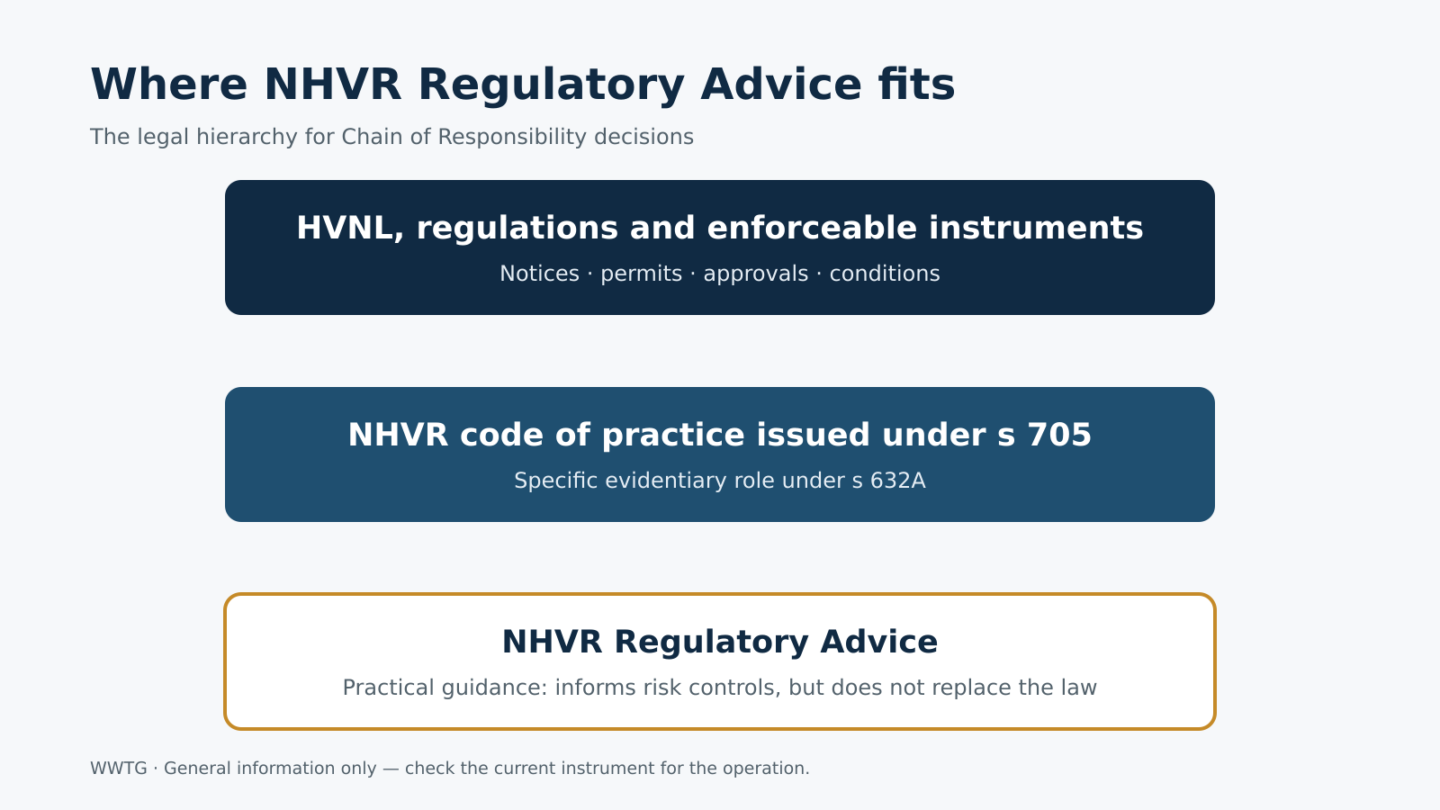
No. NHVR Regulatory Advice is general regulator guidance, not legislation, a legal instrument or an NHVR code of practice issued under HVNL s 705. It can help a business identify risks and possible controls, but it does not replace the law or guarantee compliance.
Plain English
NHVR Regulatory Advice explains the regulator’s published view of particular HVNL risks and ways businesses might manage them. It is useful—but it is not itself the law. Legal obligations come from the HVNL, national regulations, applicable notices, permits, approvals and other enforceable instruments. Regulatory Advice should not be confused with an NHVR code of practice issued under HVNL s 705. Before issuing or amending a code, the NHVR must make the draft publicly available for at least 42 days and consider submissions received during that period: s 705(3). The same 42-day public-notice and submissions requirement applies before revocation: s 705(4). Minor amendments and amendments or revocations directed by the responsible ministers are exceptions: s 705(5)–(6).
What this means operationally
Start with the current HVNL provision, regulation or legal instrument. Use the relevant Regulatory Advice to identify hazards and possible controls, assess whether they suit the operation, adapt or strengthen them where required, and record the assessment, decision, implementation and review. Recheck both the law and guidance when the operation changes.
Who it applies to
Parties in the chain of responsibility and drivers operating in HVNL-participating jurisdictions.
Example
Regulatory Advice about time-slot bookings may identify how unrealistic delivery windows can create speeding or fatigue pressure. A business does not comply merely by saving that webpage; it must assess its scheduling practices and implement controls that work in its operation.
Exceptions and traps
Following a guidance example mechanically is not a statutory safe harbour. A different control may be used, but the business must still meet the underlying duty and be able to demonstrate how the safety risk is eliminated or minimised so far as is reasonably practicable.
What changed
Current ss 705–706 give the NHVR power to issue, amend and revoke codes of practice, with consultation requirements. This replaces the former code-registration framing.
Previous rule
Earlier materials described an industry-application registration mechanism; that is not the current s 705 process.
Legal foundation
HVNL ss 26C, 632A and 705–706.
Sources & primary documents
- www.legislation.qld.gov.au/view/whole/html/inforce/2026-08-01/act-2012-021
- www.nhvr.gov.au/safety-accreditation-compliance/chain-of-responsibility/regulatory-advice
- www.nhvr.gov.au/safety-accreditation-compliance/chain-of-responsibility/regulatory-advice/the-primary-duty
WWTG verification: Current Queensland HVNL reprint, including s 705(3)–(6), s 706 and s 632A.
Frequently asked questions
Is Regulatory Advice legally binding?
No. It is regulator guidance, not legislation or an enforceable legal instrument.
Is it the same as an NHVR code of practice?
No. A code issued under s 705 has a statutory process and evidentiary role.
Does following it guarantee compliance?
No. The business must still comply with the applicable law and manage its actual risks.
Can a business use different risk controls?
Yes, where the controls meet the underlying duty and are appropriate for the operation.
Which document takes priority if guidance conflicts with legislation?
The current HVNL and enforceable instruments control.