What heavy-vehicle records must an operator keep?
Short answer
The records depend on the operation. Fatigue record keepers have specific obligations; accreditation, exemptions and access conditions can add others. Useful evidence of safe practices is broader than the documents expressly required by law.
Plain English
Start by identifying the vehicles, drivers, work-and-rest arrangements and operating authorities used by the business. An operator running local deliveries under standard hours can have different record obligations from one using alternative compliance hours, an exemption or an accredited mass-management system.
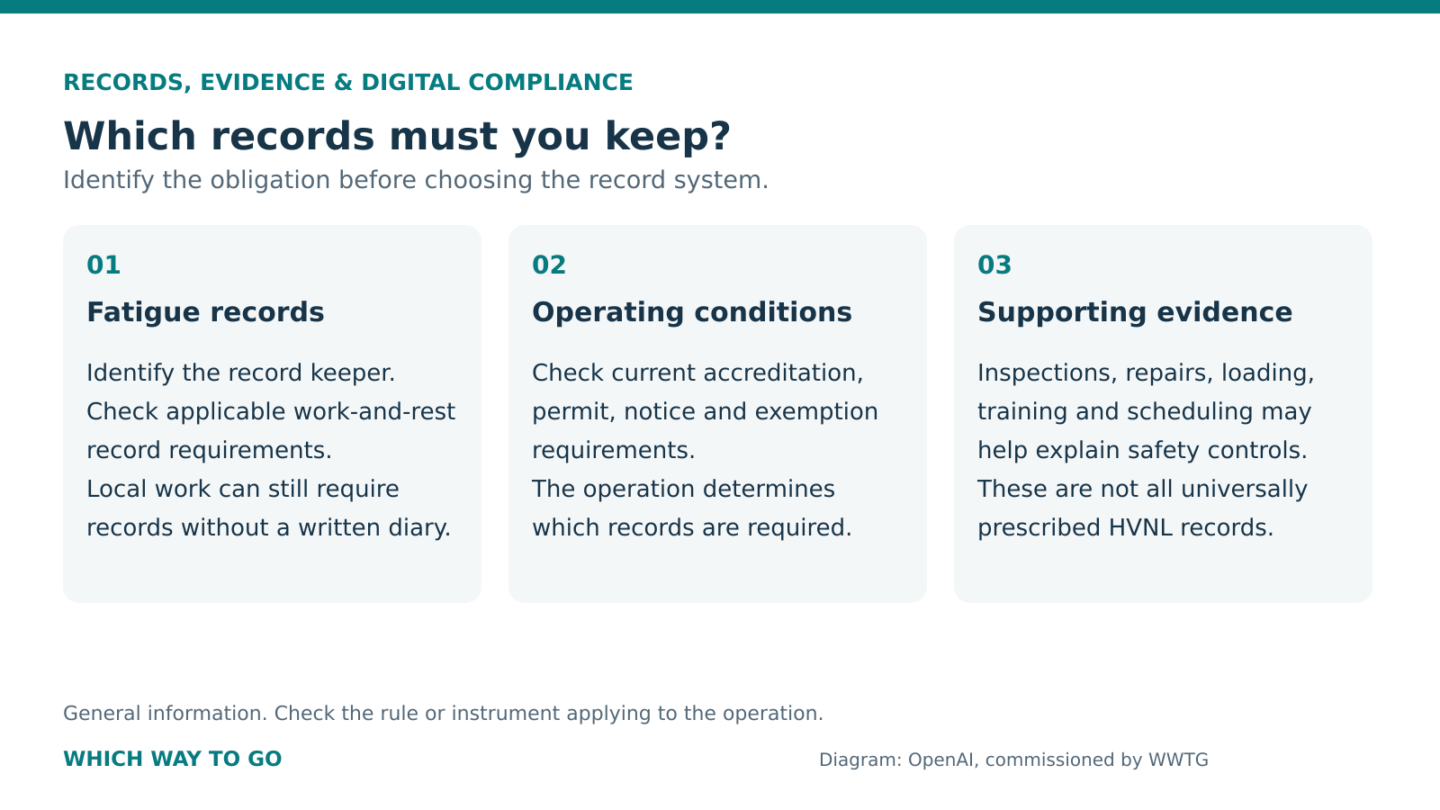
For fatigue-regulated operations, identify the record keeper. Depending on the arrangement, this can be the employer, the accredited operator or a self-employed driver. Local work does not automatically remove record-keeping obligations just because a written work diary is unnecessary.
Required fatigue records can include driver and licence details, work-and-rest information, diary entries, rosters, trip schedules and payment records. The applicable category determines the precise requirements.
For other parts of the operation, check the current accreditation standards and conditions, permits, notices and exemptions. Do not assume an old NHVAS checklist fully describes a current HVA scheme or ACA obligation.
These requirements apply in HVNL-participating jurisdictions: ACT, NSW, Queensland, South Australia, Tasmania and Victoria. WA and NT have separate requirements; check each part of a cross-border journey.
What this means operationally
As a practical control, keep a records register showing each record category, the rule or condition requiring it, who collects it, where it is stored, when it must be supplied and how long it is retained.
Supporting evidence may include inspection reports, defect repairs, weighing results, loading checks, training records and scheduling decisions. Keeping these can help explain how safety risks were managed, but this article does not claim every item is a universally prescribed HVNL record.
General information, not legal advice. Check applicable law and instruments for the actual operation. Seek advice for significant enforcement or disputed evidence issues.
Who it applies to
Transport operators and fatigue record keepers in HVNL-participating jurisdictions.
Example
A local-delivery business may not need its drivers to use written work diaries for qualifying local work. It should still identify and fulfil the applicable local-area record requirements.
Exceptions and traps
Buying compliance software does not settle which records your business must keep or who is responsible for them.
Legal foundation
HVNL Chapter 6, Part 6.4, Division 3 and s 341; applicable accreditation and operating conditions.
Sources & primary documents
- www.nhvr.gov.au/safety-accreditation-compliance/fatigue-management/record-keeping-requirements
- www.legislation.qld.gov.au/view/whole/html/inforce/current/act-2012-hvnlq
WWTG verification: Queensland Legislation (published law), NHVR (published guidance)
Frequently asked questions
Does local work mean no fatigue records?
No. Check the local-area requirements and any applicable exemption.
Can the driver be the record keeper?
Yes, including in relevant self-employed arrangements.
Does an external provider take over every obligation?
Do not assume so. Define responsibilities and check the law and conditions applying to the arrangement.