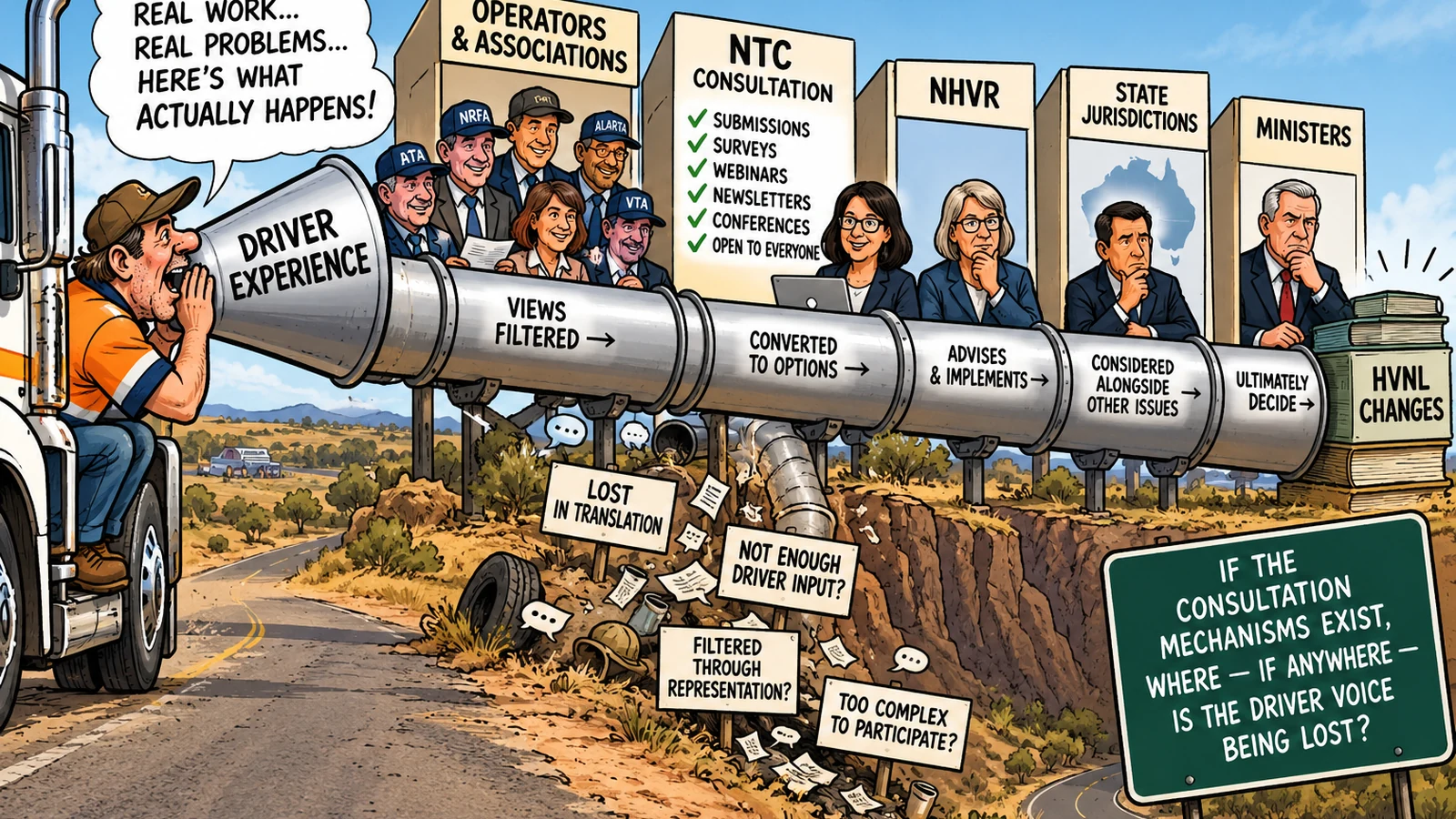
Australia’s heavy-vehicle rulemakers say every driver has an opportunity to participate in consultation — but an interstate truck ride has raised a different question: how effectively does the experience of people behind the wheel reach the decision-making process?
The issue emerged during WWTG’s interview with NHVR CEO Nicole Rosie and road transport and road safety advocate Rod Hannifey following their Dubbo-to-Brisbane truck run.
Rosie acknowledged that consultation conducted largely through organisations representing operators could leave something behind.
“Often in all of that, a driver’s voice or perspective could be lost,” Rosie said.
Hannifey proposed a more direct driver consultation forum, with people drawn from different parts of the industry providing practical input from the road.
Rosie described the idea as valid and said she would take the point back to the National Transport Commission as well as consider greater driver involvement. The interview itself did not establish that such a forum had been created.
NTC says the door is open
WWTG subsequently put questions about driver-level consultation to the NTC.
The commission says its online consultations are open to anyone and people can lodge a submission or complete a questionnaire.
It also points to a substantial consultation program around changes to the Heavy Vehicle National Law.
The NTC says it produced explainer videos, seven newsletters, webinars, online material, a summary version of its Consultation Regulatory Impact Statement, an online survey and a questionnaire.
Senior NTC people have also spoken at seven conferences attended by drivers, including events involving NRFA, ALARTA, ATA and VTA.
The NTC says its work depends on input from industry, governments and the workforce.
That response changes the question.
The issue is not whether consultation exists. It clearly does.
The question is who it reaches, who participates, and how effectively the operational experience of drivers makes its way through that process.
Representation and participation aren’t quite the same thing
Industry associations play an important role representing members and putting developed policy positions to government.
But a driver encounters regulation differently.
Rules become schedules, loading decisions, rest opportunities, access restrictions, roadside interactions and requirements attached to the equipment being operated.
Hannifey’s argument is that this experience deserves a direct pathway into the discussion.
His proposal does not mean one driver — or one consultation group — could represent an industry as diverse as road transport. Different sectors, tasks, businesses and operating environments produce different experiences.
It does raise a legitimate question about whether the current system captures enough of them.
Who actually makes the decision?
There is another complication.
Rosie told WWTG that the NHVR doesn’t control every issue drivers bring to it. Roads principally sit with state road managers, access decisions involve jurisdictions and national rule development runs through the NTC process. She described the NHVR as being on the front line between industry and those bodies.
The NTC makes another distinction: it advises Australian transport ministers on nationally consistent policy and regulatory reform, but ministers ultimately decide changes to the law.
It says operational issues involving day-to-day administration or enforcement of the HVNL should generally be raised with the NHVR, while national policy issues and ideas for future reform can be taken to the NTC.
That means a driver’s concern can potentially pass through several organisations before somebody with the relevant authority can act on it.
Finding the missing link
The evidence does not establish that industry associations are preventing driver views reaching policymakers, nor that NTC consultation is inadequate.
But Rosie’s acknowledgement that a driver’s perspective can be lost, alongside the NTC’s description of an extensive consultation program, leaves an important question.
If the consultation mechanisms exist, where — if anywhere — is the driver voice being lost?
Heavy-vehicle policy passes through a complex chain of drivers, operators, representative organisations, regulators, rulemakers, jurisdictions and ultimately ministers.
The test is not simply whether consultation occurred. It is whether the practical experience from the driver’s seat makes it through that chain and is reflected in workable rules.