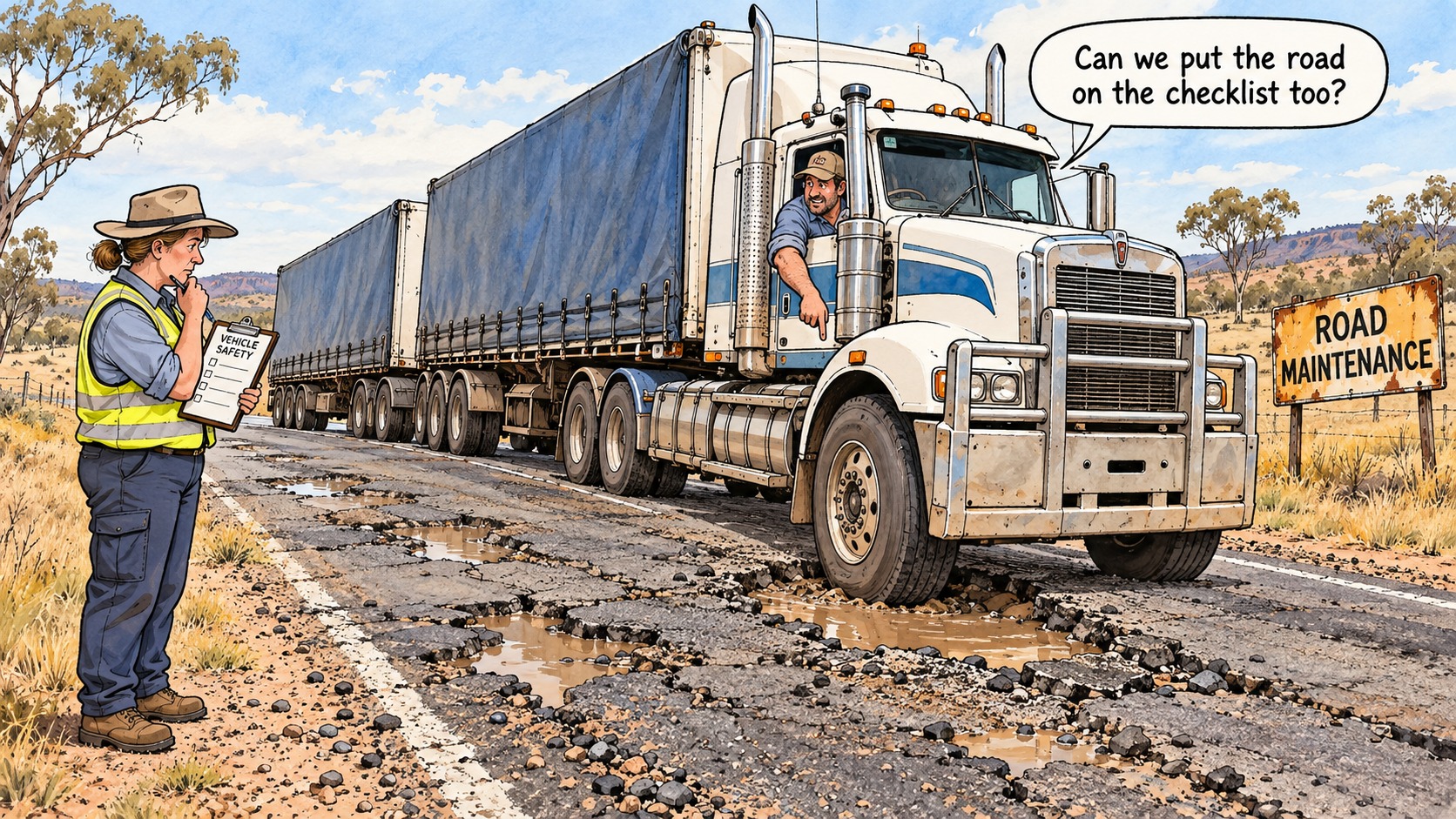
Road condition does not excuse an unsafe truck — but regulators also need to understand the environment operators are working in.
That was one of the more nuanced discussions to emerge after National Heavy Vehicle Regulator chief executive Nicole Rosie spent a full shift in a B-double with road transport advocate Rod Hannifey from Dubbo to Brisbane.
Speaking to WWTG at BP Heathwood immediately after the run on 24 September, Rosie said the trip reinforced the effect poor road surfaces can have on trucks and the people inside them.
Hannifey used the run to demonstrate the repeated impacts a heavy vehicle can experience on deteriorated road surfaces, arguing that a severe impact may contribute to a component failure that only becomes apparent later.
Rosie said the regulator needs to be sensible and proportionate, while also rejecting the idea that difficult operating conditions should mean lowering vehicle-safety standards.
“I think the regulator has to be sensible and proportionate.”
Her broader point was that the obligation runs in both directions: regulators should understand the operating environment, while operators working on particularly punishing roads should adapt their maintenance systems to the higher exposure.
The road can be part of the risk
Rosie said it was apparent that infrastructure condition can affect vehicles and maintenance, and acknowledged the difficulty of driving some roads without experiencing additional wear.
But she also said higher-risk operating conditions strengthen the case for an appropriate maintenance program rather than removing the obligation to keep the vehicle safe.
That distinction matters because road maintenance and heavy-vehicle enforcement sit with different parts of the transport system.
The NHVR is not the road owner. Its own access guidance states that road funding and maintenance responsibilities remain with state, territory and local governments.
For the wider infrastructure picture, see WWTG’s report on the Victorian audit that found 48 per cent of state roads were poor or very poor by remaining useful life in 2024.
Drivers often see one regulator — but the system has several owners
The conversation repeatedly returned to an issue that is easy to miss from the driver’s seat: the organisation at the front counter is not necessarily the organisation controlling the underlying decision.
Rosie said the NHVR can find itself between industry and state governments, police, road managers or national rule-setting processes.
For restricted heavy-vehicle access, for example, the NHVR administers the application process and ultimately issues the authority, but affected road managers must consent to use of their infrastructure.
Likewise, national heavy-vehicle law reform is developed through the National Transport Commission and government process, while the NHVR administers and enforces the law in participating jurisdictions.
WWTG has separately published a plain-English explainer setting out who controls heavy-vehicle rules, access, roads, rest areas and enforcement.
Rest areas showed why timing of consultation matters
Hannifey also used the trip to discuss rest-area design. His argument was not simply that more facilities are required, but that seemingly small design decisions can affect whether a facility works properly for a driver trying to rest in a heavy vehicle.
Rosie said operational voices are most useful when they are connected with the planning and design process early, rather than arriving when a project is already being delivered against an established scope, budget and deadline.
She said one useful role for the NHVR could be helping connect industry with the organisations that actually make those infrastructure decisions.
What happens next?
The significance of the Dubbo-Brisbane run will ultimately depend on whether the conversations produce changes after the truck is parked.
Rosie told WWTG she would take Hannifey’s concerns back to the regulator. Hannifey raised 32 questions during the trip. She did not promise a six-monthly meeting or that the NHVR could solve every item, but said she expected to loop back to Hannifey where work progressed on matters they had discussed.
In a follow-up email on 1 October, Hannifey said he had not yet received any follow-up. That records his position on that date; it does not establish whether internal work or referrals had occurred.
She has also encouraged members of her team to consider spending a full shift or overnight with drivers so policy and regulation can be tested against what happens on the road.
WWTG has asked Queensland’s Department of Transport and Main Roads about road-condition reporting, early driver involvement in rest-area planning and design, and how lessons from completed projects are fed into future facilities.
TMR says industry experience informs planning
In a response supplied on 1 October, a TMR spokesperson said the department worked closely with the freight industry to ensure industry experience helped inform infrastructure planning and investment. The spokesperson pointed to road and rest-area improvements through programs including the $9 billion Bruce Highway Targeted Safety Program.
Accompanying background material described engagement with the Queensland Trucking Association, freight operators and other stakeholders during planning, business case development and detailed design of rest-area projects. It also described industry input through the Bruce Highway Advisory Council and an audit of more than 1,000 Queensland rest areas to inform planning, including layouts and amenity levels.
The response provides information about industry consultation and planning. It does not specifically identify the process for reporting or assessing heavy-vehicle damage attributed to road condition, the design requirements for gradient or camber, combination length and manoeuvring space, or how completed-project feedback changes future designs. Those remain unanswered details, rather than evidence that no process or standards exist.
In a response supplied on 5 October, an NTC spokesperson said drivers could call or email the commission about national policy issues and ideas for future reform. Day-to-day administration and enforcement concerns should go to the NHVR. The commission said its HVNL consultation included videos, newsletters, webinars, a shorter impact-statement summary, an online survey and a questionnaire. It also said its leaders spoke at seven conferences attended by drivers. The response did not provide a breakdown of participating working drivers or identify which events were truck shows.
Sources
TMR statement and accompanying background supplied to WWTG, 1 October 2026; Rod Hannifey follow-up email, 1 October 2026; NTC statement supplied to WWTG, 5 October 2026.
WWTG interview with Nicole Rosie and Rod Hannifey, BP Heathwood, 24 September 2026; original recording and transcript; NHVR road-access and road-manager guidance; National Transport Commission HVNL material.