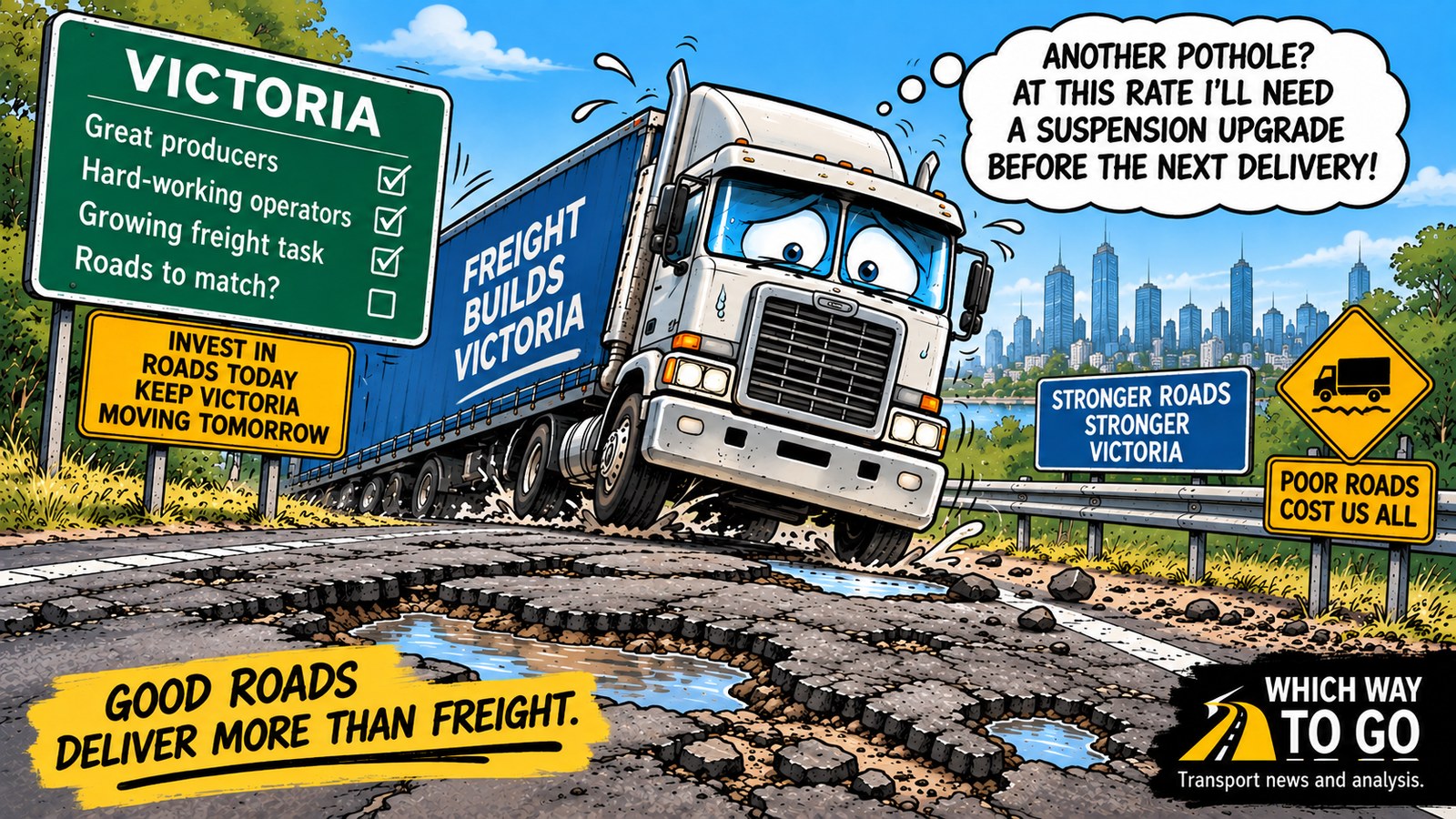
Almost half of Victoria’s state road network was rated poor or very poor in 2024 as the freight task continued to grow, according to a new audit of the state’s pavement-maintenance system.
The Victorian Auditor-General’s Office found around 48 per cent of state roads were in poor or very poor condition when measured by remaining useful life, up from 39 per cent in 2021.
The share rated very poor — meaning less than five years of remaining useful life under the department’s standard — increased from 26.2 per cent to 37.04 per cent over the same period.
Regional freight roads carry the worst results
Loddon Mallee recorded the highest proportion of roads rated very poor for remaining useful life at 54.28 per cent. Hume followed at 47.98 per cent and Grampians at 39.22 per cent.
That regional result matters to freight. State roads make up about 15 per cent of Victoria’s road network by length but carry most of the state’s traffic and freight, and 82 per cent of the state network is in regional Victoria.
Freight activity increased from 45.1 billion tonne-kilometres in 2020–21 to 54 billion tonne-kilometres in 2024–25. The department expects Victoria’s total annual freight task to rise from about 440 million tonnes in 2020–21 to about 908 million tonnes by 2050–51.
Defects are outpacing repairs
The audit found the gap between defects recorded and defects repaired more than doubled between January 2025 and June 2026.
It also found only 0.4 per cent of state roads were rehabilitated during the 2024–25 planned-works season, even though 10.3 per cent of the network was rated very poor for roughness in the 2024 survey.
The department’s 2026–27 business case estimated it would cost more than $3 billion a year to maintain pavement condition at existing levels while replacing age-expired assets. Total road-asset-management funding for 2026–27 is approximately $1.39 billion after an additional $352 million pothole allocation.
Those figures are not directly like-for-like: the $3 billion estimate concerns pavement condition and age-expired assets, while the $1.39 billion allocation covers broader road assets and asset-management work. They nonetheless show the scale of the maintenance problem identified by the audit.
Official reporting masks the condition gap
The department reported that 95.3 per cent of regional roads met its roughness standard in 2024–25. The condition survey, using a different measurement basis, found 23.31 per cent were poor or very poor for roughness and 50.38 per cent were poor or very poor for remaining useful life.
VAGO concluded the public targets do not provide meaningful insight into the condition of the network or the effect of maintenance spending.
For operators, the report does not quantify repair, tyre, fuel, delay or insurance costs and does not provide a consolidated list of freight routes facing new access restrictions. The latest 2026 condition survey had not been validated when the report was published; results are expected in October.