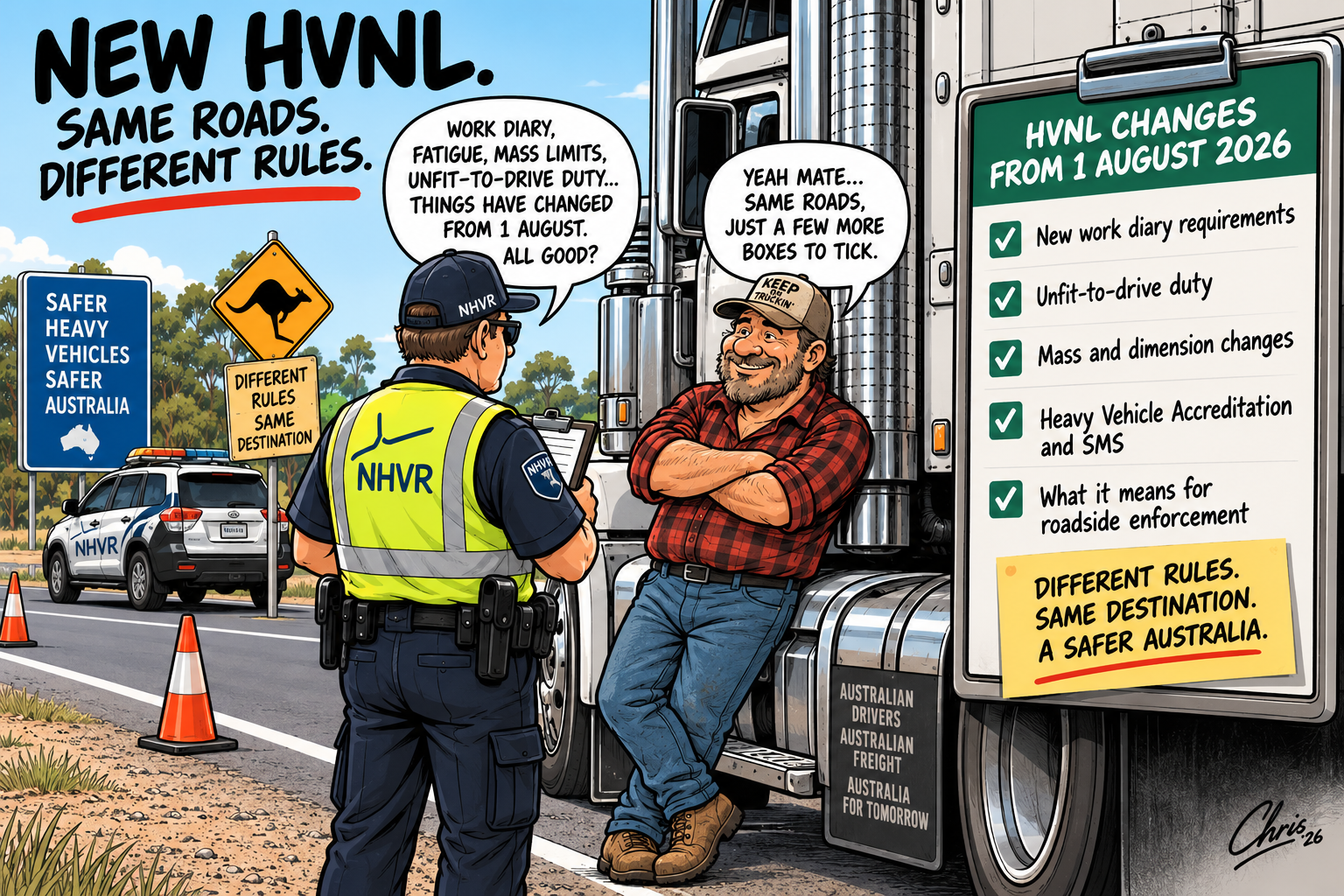
QUICK FIRE — HVNL 2026
The amended Heavy Vehicle National Law has now been in force for more than six weeks. The legislation changed on 1 August 2026, but for a driver being intercepted at the roadside the obvious question is simpler: what is actually different?
The answer is that some changes affect what a driver records or what a vehicle can legally carry, while others sit further back in an operator’s safety and accreditation systems.
Work diaries have been simplified
The updated written work diary reflects the amended law. The NHVR says drivers no longer have to mark the day of the week, mark standard hours, or record work and rest totals. Drivers also no longer have to return a lost or stolen written work diary to the NHVR if it is later found or returned.
Existing diaries do not suddenly become useless. The NHVR says drivers can continue using their current written work diary until it is completed, including drivers moving from BFM or AFM to Alternative Compliance Hours.
There is now an explicit ‘unfit to drive’ duty
The amended law introduced a specific safety duty preventing a driver from driving when unfit because of factors including illness, injury, drugs, alcohol or fatigue. Importantly, the NHVR says the change also gives drivers legal authority to refrain from driving or stop driving when they are unfit.
That makes fitness more than a fatigue-hours question. A driver can be inside the permitted work hours and still be unfit to drive.
Mass and dimension rules moved too
The reform increased the general vehicle length limit from 19 metres to 20 metres and changed a number of mass provisions, including concessions associated with Euro VI vehicles. The NHVR has also updated the National Heavy Vehicle Inspection Manual to version 3.2 to reflect changes commencing on 1 August.
There is an important complication around the Euro VI mass exception. The NHVR says the current regulation does not fully reflect the approved policy intent. While the NTC works on an amendment, the regulator says its officers will administer and enforce the provision according to that approved intent.
Accreditation has changed more fundamentally
The old NHVAS is being replaced by Heavy Vehicle Accreditation. Existing NHVAS operators can continue until their accreditation expires, but no new NHVAS accreditation can be granted after 1 August. HVA is built around a whole-of-business Safety Management System and a new audit framework.
That does not mean every heavy-vehicle business is suddenly legally required to have an SMS. The NHVR says an effective SMS is not a legal requirement for most heavy-vehicle businesses, but it is required for operators participating in HVA.
So what are officers doing differently?
Roadside enforcement itself still covers the familiar fundamentals: fatigue and work diaries, vehicle standards, mass and dimensions, and load restraint. NHVR Safety and Compliance Officers also use risk profiling and targeted enforcement tools during intercepts.
What WWTG now wants to establish is how the amended law has changed actual enforcement practice since 1 August: what officers have been instructed to look for, whether intercept outcomes have shifted, what education-versus-enforcement approach is being taken during transition, and which new provisions are generating the most questions or breaches.
Update, 21 September: The NHVR has since clarified when a roadside compliance concern can lead to closer examination of an operator’s Safety Management System. Read: From roadside stop to company audit: when does the NHVR look beyond the truck?