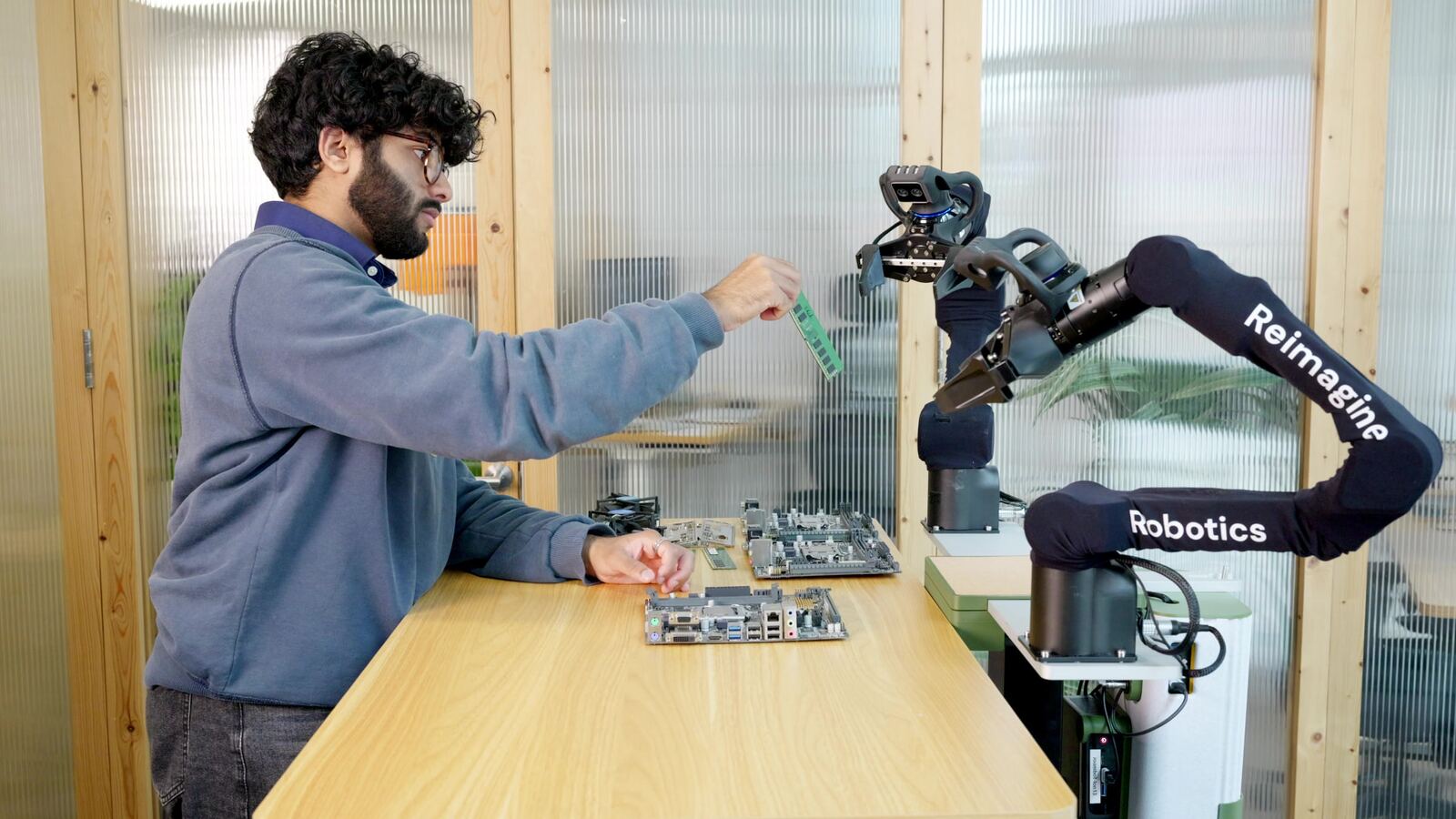
What if training a warehouse robot looked less like programming and more like showing a new worker what to do?
That is the proposition behind Reimagine Robotics, a company built in London and Sydney by former members of Google DeepMind’s Applied Robotics team.
The company emerged from stealth this month with a simple pitch: show the robot the task, watch it attempt the job and correct it where it goes wrong.
Reimagine says the approach is designed to let people on the floor adapt robots as work changes rather than calling in a specialist programmer every time the process moves.
The interesting part is who becomes the robot expert
Industrial robotics has traditionally rewarded repeatability. That makes automation powerful when the task stays stable, but potentially expensive and cumbersome when products, layouts or processes change frequently.
Reimagine is attacking that gap from the other direction. Instead of assuming every useful behaviour can be engineered in advance, it wants workers to train and correct the machine in the real environment.
The company says early deployments include robots tending 3D printers overnight and a three-robot disassembly cell used in recovery of materials from hard drives. It has also said customers are already operating in London and Sydney.
In one project, Reimagine says the time needed to prototype and test a new robot behaviour fell from about a day to around 10 minutes.
That could change the warehouse skills debate
Automation is usually framed as a workforce subtraction story: how many people can the machine replace?
This model raises a different possibility. If a frontline worker can teach, correct and redeploy a robot, operational knowledge becomes part of the automation system itself.
The person who understands why a carton jams, which product is awkward to handle or where a process loses time may become the person best placed to improve the robot.
That does not settle the employment debate. Easier-to-use robots could still reduce labour demand for some tasks, and company claims about usability will need to be tested at scale.
But it does make the skills question more interesting.
An Australian connection worth watching
Reimagine describes itself as built in London and Sydney, and its team draws on Australian as well as UK robotics expertise.
For Australian warehousing and manufacturing, the useful question is whether no-code or low-code robot training can make automation viable for operations that are too variable to justify traditional fixed automation.
If it can, the next big warehouse technology skill may not be writing robot code.
It may be knowing the job well enough to teach the robot.
Reporting note: WWTG reviewed Reimagine Robotics’ company material, public launch material and current LinkedIn company information. Deployment and training-time results are company-reported and customers are not named in the material reviewed.