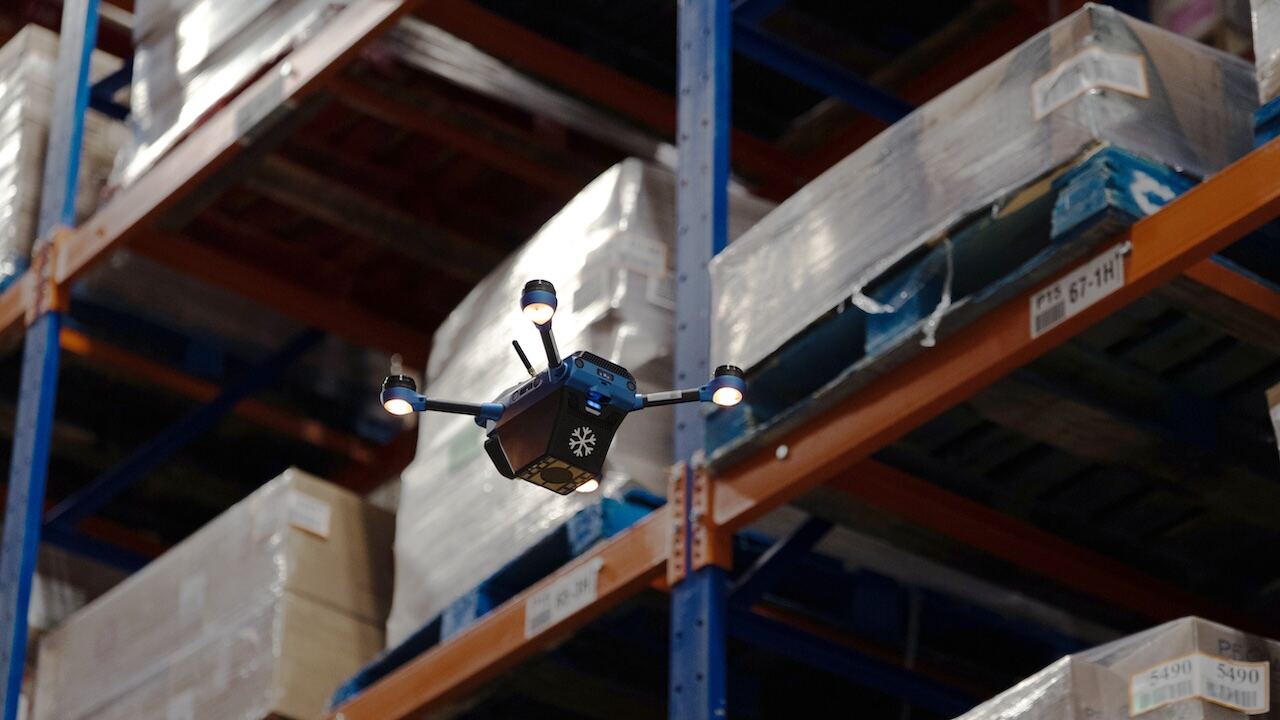
Minus 29 degrees Celsius is a miserable place to do a stocktake.
Corvus Robotics thinks it is a much better place to send a robot.
The US warehouse-technology company has developed a version of its Corvus One autonomous inventory drone designed to operate continuously in freezer environments down to minus 20°F — about minus 29°C.
The drone flies warehouse aisles and scans inventory without a pilot, with the company saying its cold-chain system is engineered to deal with frost, condensation, low contrast and airflow from industrial freezer blowers.
The viral number is the temperature. The freight story is the count
Cold storage makes an ordinary warehouse problem harder.
Manual inventory checks put people into uncomfortable conditions, specialist protective clothing and limited exposure windows. Meanwhile, frozen and temperature-sensitive goods can make inaccurate stock data expensive when it affects first-in-first-out rotation, replenishment or spoilage.
Corvus says its system can remain inside the freezer and run autonomous cycle counts without requiring Wi-Fi, GPS or navigation markers.
Kroger is identified by Corvus as an early user of the cold-chain version in live freezer operations.
The technology is already being tested at wider scale
The cold-chain version sits inside a larger Corvus inventory-drone deployment.
In a separate rollout, Southern Glazer’s Wine & Spirits has deployed more than 40 Corvus drones across nine distribution centres. Corvus and Southern Glazer’s say the system has completed about 5,000 flights and identified more than 35,000 verified inventory discrepancies.
That customer also reported moving from quarterly inventory validation to a biweekly cadence.
Those figures are not cold-chain-specific, but they show why autonomous counting is attracting attention: the value may come less from replacing one annual stocktake than from making inventory checking frequent enough to catch problems before they reach picking and outbound freight.
Why Australian warehouses should care
Australia has large grocery, pharmaceutical, food-service and cold-chain networks where labour availability, inventory accuracy and worker exposure to harsh environments all matter.
A drone does not solve every inventory problem. It still depends on readable stock identifiers, accurate system integration and a storage environment the sensors can see. Corvus itself notes limitations around some multiple-deep storage positions.
But there is a broader automation lesson here.
The strongest robot use cases are often not the most human-looking. They are the tasks where a machine can repeatedly do something dull, difficult or uncomfortable while generating better operational data.
A drone flying through a freezer at minus 29 degrees may be a better example of useful automation than a humanoid robot doing a backflip.
Reporting note: WWTG reviewed current Corvus Robotics cold-chain material and its Southern Glazer’s deployment case study. The 35,000-discrepancy figure comes from the wider Southern Glazer’s rollout and is not attributed specifically to cold-chain operations.