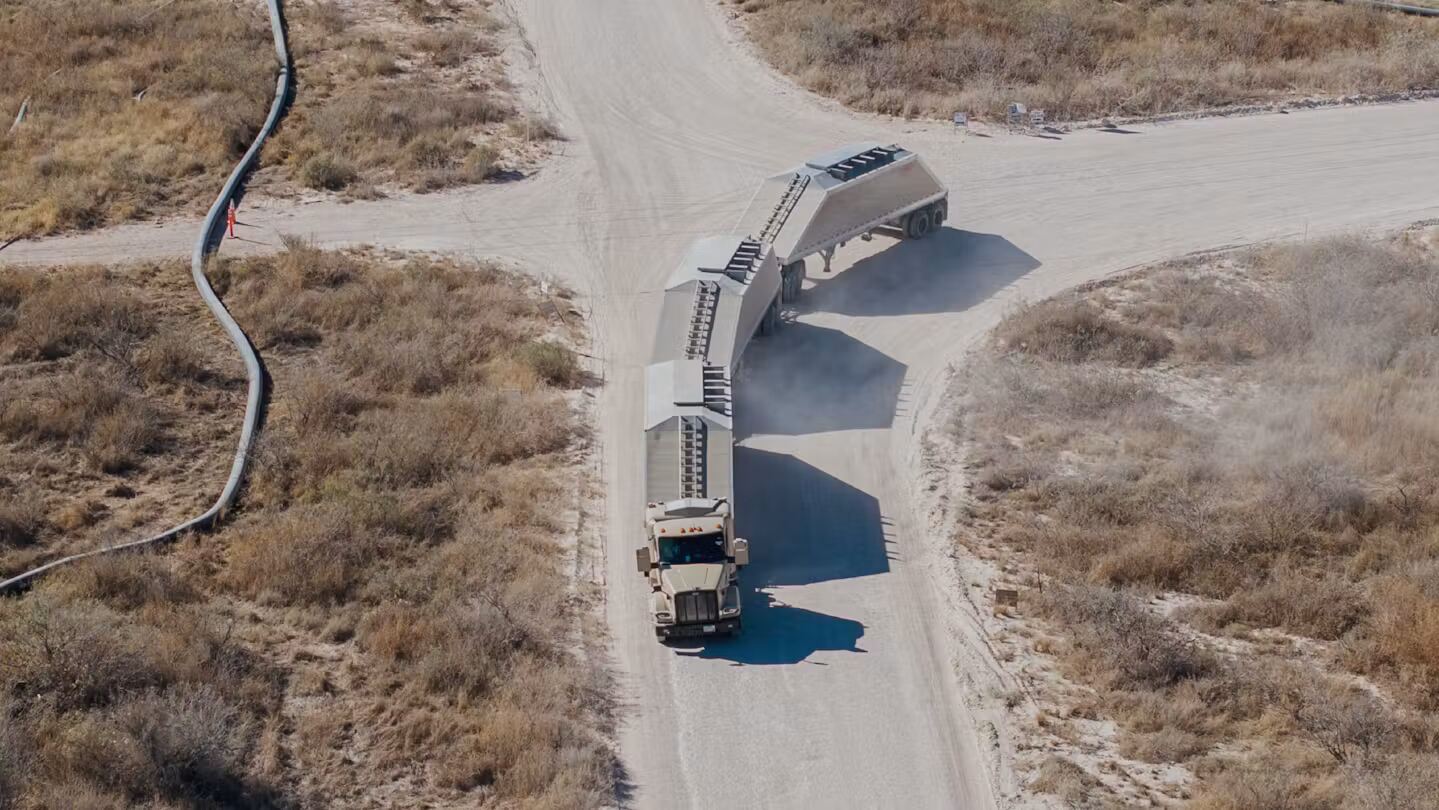
Three trailers. About 50 metres from the front bumper to the rear of the last trailer. Roughly 125 tonnes loaded. And nobody in the cab.
For an Australian freight audience, the extraordinary part of Kodiak AI’s latest autonomous trucking operation is not the size of the combination. Road trains have made long, heavy combinations familiar here for decades.
It is that the combination is already being used commercially without a human driver.
Kodiak says its driverless system is hauling triple trailers for Atlas Energy Solutions in the Permian Basin of Texas and New Mexico, moving frac sand between industrial sites. Since the triple configuration began operating in February, the company says it has carried more than 1,400 triple-trailer loads.
Why three trailers matter
The attraction is straightforward. Kodiak says the triple combination carries about 50 per cent more sand than the double-trailer configuration it replaces.
But adding another trailer is not simply a matter of teaching software that the truck is longer. Kodiak says air pressure can take about 1.5 seconds to reach the brakes on the rearmost trailer. The autonomous driving system therefore has to account for the different braking response, greater length and changing vehicle dynamics.
The company also says the triple operations are being conducted on routes approved for the combination. That distinction matters: this is an industrial freight use case in a controlled operating environment, not evidence that a 50-metre driverless combination could be dropped onto an Australian public road tomorrow.
It is no longer one truck in a demonstration
The scale is what makes the development worth watching. Kodiak reported 35 customer-owned driverless trucks operating for Atlas at the end of the second quarter of 2026, more than 40,000 cumulative paid driverless operating hours and more than 20,000 loads delivered across the program.
Atlas and Kodiak are working toward a 100-truck autonomous fleet by mid-2027. The companies have also said they expect Atlas vehicles to begin operating on public roads in 2027, subject to regulatory and operational milestones.
The Australian question
Australia already has several conditions autonomy developers like to talk about: long distances, repetitive freight tasks, remote operations and some very large combinations.
But the comparison should not be oversold. Australian road freight has different rules, infrastructure, road-manager responsibilities, mixed traffic and operating conditions. A mine or oilfield logistics task is also very different from putting a driverless road train through a regional town or onto a national highway.
The useful lesson is narrower.
Autonomous heavy vehicles are moving beyond the question of whether a truck can drive itself. Operators are now experimenting with what happens when autonomy changes the productive design of the combination itself.
For Australia, where productivity has always been closely tied to vehicle configuration, that may prove the more interesting question.
Reporting note: WWTG reviewed current material published by Kodiak AI and Atlas Energy Solutions. Operational and performance figures are company-reported. No Australian deployment is claimed or implied.