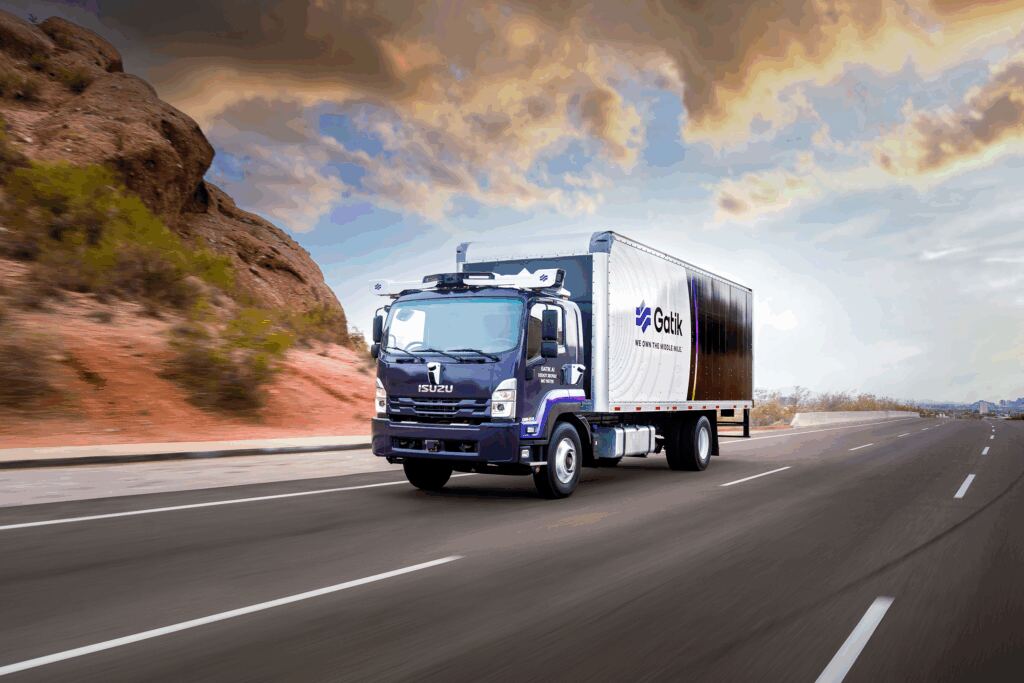
Eighty-five thousand fully driverless orders changes the conversation.
Autonomous trucking is still often discussed as though the industry is waiting for a single dramatic moment when a robot truck suddenly replaces a driver on an interstate run.
Gatik is pursuing a less cinematic model: repetitive freight movements between distribution centres, warehouses and stores.
The company said this week it has now completed 85,000 fully driverless orders, achieved 99 per cent on-time delivery across its operations and secured more than US$600 million in contracted revenue. It announced the figures alongside a US$200 million Series D funding round.
Not the longest run — the most repeatable one
Gatik’s focus is the “middle mile”: high-frequency regional routes that connect distribution infrastructure rather than trying to automate every possible trucking task.
That is important because the commercial case for autonomy may not begin with the longest highway route. A repeatable shuttle can have known origins and destinations, predictable freight volumes, defined operating windows and infrastructure that can be engineered around the task.
Earlier this year Gatik said its driverless trucks were operating for major retail and consumer-goods customers in Texas, Arkansas and Arizona, with commercial operations also established in other North American markets. PepsiCo announced a multi-year agreement with Gatik in June.
The Australian version could look surprisingly ordinary
If autonomous freight reaches scale in Australia, the first useful deployment may not resemble a science-fiction B-double running from Brisbane to Melbourne.
It could be much less dramatic: a truck shuttling repeatedly between a distribution centre and another warehouse, a manufacturing plant and a logistics hub, or two sites connected by a highly predictable corridor.
That would fit one of the central lessons emerging from commercial automation: constrain the problem before trying to solve every road, customer and weather condition at once.
Commercial proof still needs context
Gatik’s numbers are its own reported performance figures, and North American deployments operate within a regulatory and commercial environment different from Australia’s.
Autonomy also does not remove the rest of the freight task. Loading, unloading, maintenance, remote support, incident response, compliance and interaction with people remain operational questions even when the driving function is automated.
But 85,000 orders is enough to make one point difficult to ignore.
The important autonomous-trucking question is shifting from can a truck move freight without a driver? to which freight tasks are predictable enough, valuable enough and frequent enough to automate first?
For Australian distribution networks, that is a much more practical question.
Reporting note: WWTG reviewed Gatik’s August 2026 funding announcement, its 2026 commercial-deployment material and PepsiCo’s partnership announcement. Performance and revenue figures attributed to Gatik are company-reported.