What is the difference between an infringement penalty, a court fine and a maximum penalty?
Short answer
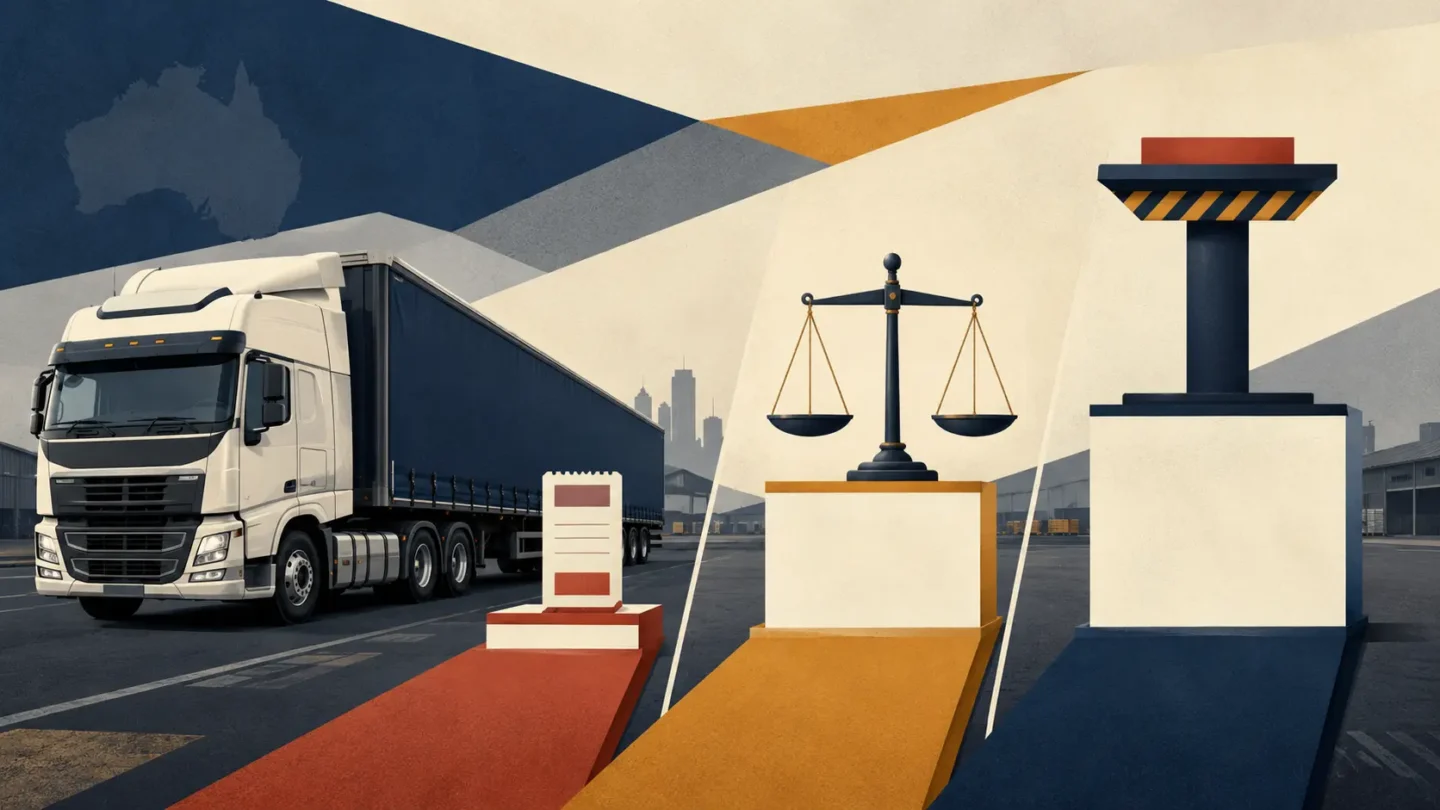
An infringement penalty is the amount offered to resolve a prescribed allegation without a court hearing, a court fine is the amount a court actually imposes after guilt is established, and the maximum penalty is the statutory ceiling the court cannot exceed.
Plain English
These amounts answer different questions. The infringement amount is printed on a notice and provides a non-court pathway for an infringeable offence. NHVR guidance states it is set at 10 per cent of the maximum court-imposable penalty.
A court fine is decided by a judicial officer after a guilty plea or finding. The court is not restricted to the original infringement amount and may impose a lower or higher fine, subject to the applicable maximum and sentencing law. Court costs and other HVNL orders may also be available.
The maximum penalty is not a forecast. It is the highest fine allowed for the offence. Under s 596, if a penalty provision does not state a different body-corporate maximum, a corporation can face up to five times the individual maximum. The applicable maximum must therefore be checked for the defendant type and the date of the alleged offence.
What this means operationally
Do not report a statutory maximum as the fine someone will receive, and do not assume electing court caps the exposure at the infringement amount. Check the offence section, the current indexed schedule, whether the defendant is an individual or corporation, and whether additional orders are available.
Before deciding whether to pay, seek review or go to court, preserve the notice and evidence, diarise the deadline and obtain legal advice where the allegation or potential consequences are significant.
Who it applies to
Individuals, drivers, operators, companies, executives and advisers interpreting an HVNL notice, charge, court report or media statement.
Example
A notice offers an infringement amount for a prescribed offence. If the recipient elects court, the magistrate is not deciding whether to preserve that offer; the court determines guilt and, if necessary, an appropriate sanction within the statutory range.
Exceptions and traps
A court may have powers beyond a fine, including injunctions, commercial-benefit orders, registration orders, supervisory intervention orders and other sanctions where the statutory conditions are met. A maximum penalty can also differ for an individual and a body corporate.
Jurisdictional procedure, costs, appeal rights and demerit-point consequences are not uniform. Western Australia and the Northern Territory use their own domestic enforcement laws rather than the HVNL.
What changed
The current figures must be read from the NHVR schedule applying from 1 August 2026 to 30 June 2027 because the 2026-27 schedule changed again when the 2025 HVNL amendments commenced on 1 August 2026.
Legal foundation
Heavy Vehicle National Law ss 591, 593, 596-608 and 736-737; applicable participating-jurisdiction infringement and sentencing laws
Sources & primary documents
- www.legislation.qld.gov.au/view/whole/html/inforce/current/act-2012-hvnlq
- www.nhvr.gov.au/law-policies/penalties-and-infringements
- www.nhvr.gov.au/law-policies/prosecutions/going-to-court
- www.nhvr.gov.au/law-policies/prosecutions/court-outcomes
WWTG verification: Queensland legislation, NHVR
Frequently asked questions
Why is the maximum penalty much higher than the infringement?
The infringement is a fixed alternative to prosecution for eligible offences; the maximum is the outer limit available to a court.
Can a court impose more than the infringement amount?
Yes. The court is not limited to the notice amount, although it cannot exceed the applicable statutory maximum.
Does a company face the same maximum as a driver?
Not necessarily. If the offence provision does not specify another corporate maximum, s 596 can make the corporate maximum five times the individual maximum.
Does the maximum penalty include court costs?
Not necessarily. Costs and other court orders may be separate from the fine.
Which penalty schedule should I use?
Use the schedule and law applying on the date relevant to the alleged offence, not an old webpage, article or saved PDF.