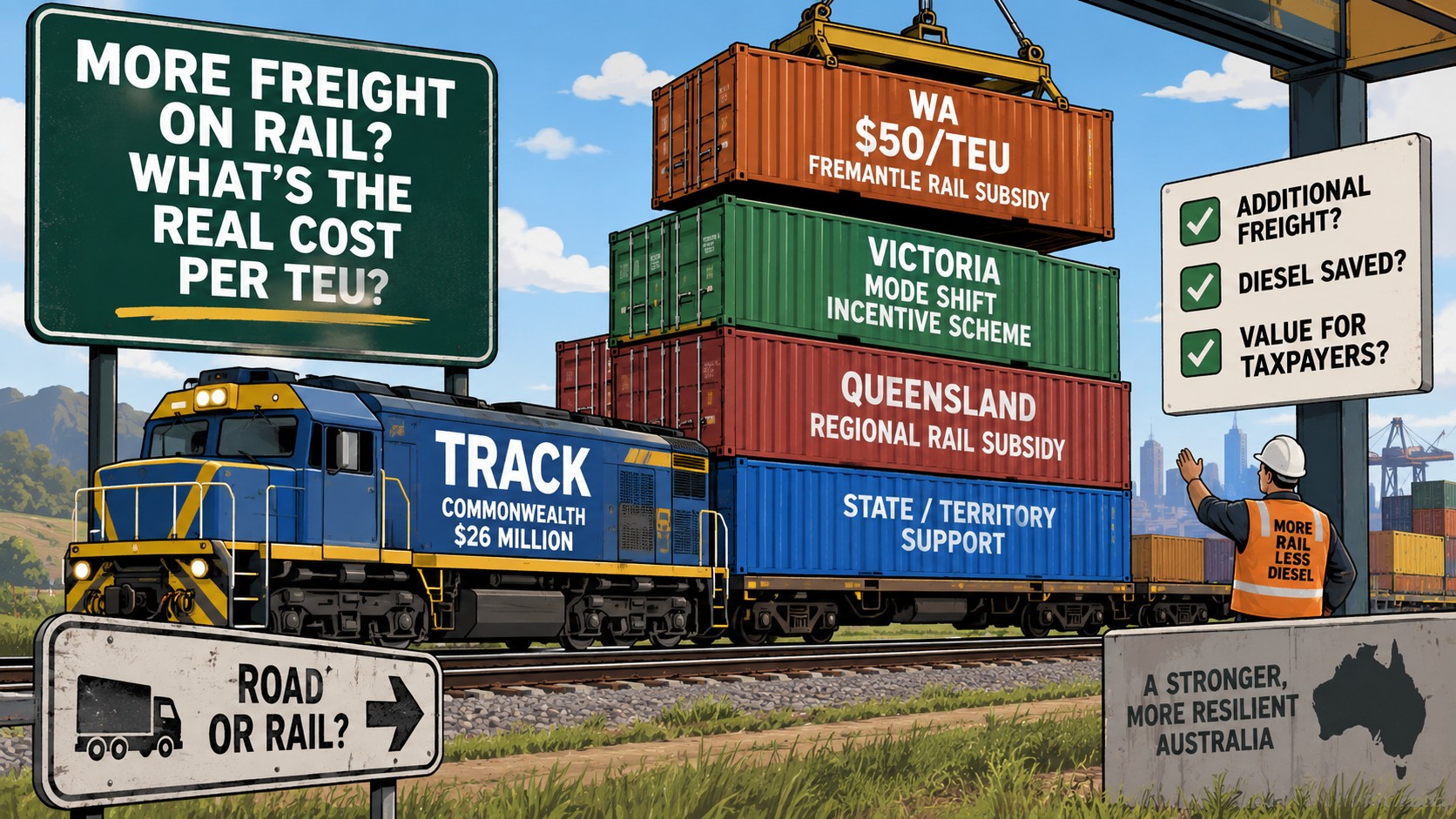
The Commonwealth’s $26 million TRACK program will ask rail operators to nominate the subsidy they need for each additional TEU, while competing on diesel savings, program outcomes and longer-term freight resilience.
The real test of the Commonwealth’s new TRACK rail-freight program will not be how much money it spends.
It will be how much genuinely additional freight moves by rail for every taxpayer dollar put into the program — and how much diesel that shift actually saves.
Round One of the Transport Resilience and Capacity Kickstart program offers eligible rail freight operators a share of up to $26 million to carry additional freight above an agreed baseline and reduce Australian diesel consumption.
Individual grants can be worth up to $10 million.
But underneath those headline figures is a more unusual mechanism.
Rather than simply funding infrastructure or providing operators with a general subsidy, TRACK is testing incentives based on additional freight moved. Applicants nominate the subsidy they require per TEU — twenty-foot equivalent unit — for their proposed project.
The Commonwealth then assesses proposals not only on the requested subsidy, but on diesel savings, broader program outcomes and longer-term freight resilience.
That means the price operators put on shifting freight becomes an important part of the contest.
How does TRACK actually work?
A TEU is the standard unit used to measure containerised freight. A standard 20-foot container represents one TEU, while a 40-foot container represents two.
Under TRACK, eligible rail operators propose projects that increase rail freight volumes above an accepted baseline.
The Commonwealth describes the program as a pilot intended to test whether incentives can increase more fuel-efficient freight movements and conserve Australian diesel. The Department says TRACK is being delivered under the National Fuel Security Plan.
Round One applications opened on 11 September and close on 1 October 2026. Eligible movements are associated with the 2026–27 program period, with successful projects subject to performance and verification requirements.
The baseline is critical.
TRACK is not intended simply to subsidise freight a railway was already carrying.
Payments relate to eligible freight movements above an agreed baseline, meaning successful operators must be able to demonstrate additional activity rather than simply reclassifying an existing freight task.
That distinction sits at the heart of whether the program ultimately represents value for taxpayers.
Operators nominate what they need
Diesel saving carries the greatest weighting in the published assessment criteria.
Of the 100 points available:
- 50 points relate to how the project saves diesel in Australia;
- 35 points relate to how it meets the program’s purpose, objectives and intended outcomes; and
- 15 points relate to improving longer-term rail freight resilience.
The Department of Infrastructure has provided WWTG with additional background explaining how the mechanism is intended to operate.
Applicants nominate the subsidy they require per TEU for their proposed project, with the competitive assessment favouring proposals capable of producing greater diesel savings for the subsidy requested.
In practical terms, that means two projects promising the same number of additional containers do not necessarily offer taxpayers the same value.
The route involved, freight volumes, competing road task, estimated diesel consumption and subsidy requested can all affect the outcome.
It also creates a figure worth watching once successful projects are known:
How much public money is required for each additional TEU moved by rail?
Proving the freight really shifted
Paying a rail operator for carrying another container is relatively straightforward.
Proving that the container represents a genuine reduction in the road freight task is harder.
The Department has told WWTG that applicants must demonstrate how they will provide assurance that proposed additional volumes come from new freight growth or road freight, rather than freight transferred from another rail operator or coastal shipping service.
That distinction matters.
Moving a container from one rail operator to another does not reduce the road freight task.
Nor does paying for freight that rail would have carried anyway demonstrate that the subsidy caused a modal shift.
TRACK therefore depends heavily on the quality of the baselines established for successful projects and how the claimed additional freight is subsequently verified.
The strongest evidence will not be the number of containers carried by successful applicants.
It will be evidence showing how many of those additional containers would otherwise have travelled by road.
How will diesel savings be calculated?
Reducing Australian diesel consumption is central to Round One.
Applicants are required to demonstrate how much Australian diesel their proposed project would save.
The Department says the methodology can be developed by the applicant.
One example could compare the route, locomotives and train configuration being proposed with the amount of diesel that would have been consumed moving the same cargo using a high-productivity road vehicle between the relevant terminals.
That raises an important methodological issue.
Intermodal rail freight does not necessarily eliminate trucks.
Road transport may still be required to move a container from its origin to a rail terminal and from another terminal to its final destination.
The quality of TRACK’s diesel-saving claims will therefore depend partly on where each comparison starts and finishes and which parts of the freight journey are included.
For operators and taxpayers trying to assess the program later, those assumptions will matter almost as much as the headline number of containers shifted.
What happens when fuel prices change?
TRACK measures diesel saving primarily as a physical transport outcome, but the economic value of those savings can change substantially with the price of fuel.
A project saving the same number of litres becomes more financially valuable when diesel prices rise and less valuable when they fall. But the physical result has not changed.
A credible evaluation of TRACK therefore needs to distinguish between additional freight moved by rail, litres of diesel actually avoided, the subsidy required to achieve that shift and the changing financial value of the fuel saved.
Can state subsidies be added as well?
Commonwealth assistance does not necessarily stand alone.
The Department says the Commonwealth wants states and territories to contribute financially to freight mode shift, and applications can score more highly where they make use of support from other jurisdictions.
That potentially creates projects receiving assistance from more than one level of government.
There is nothing inherently unusual about governments co-funding transport initiatives.
But it means the eventual assessment of value should consider the total public contribution, rather than looking only at the Commonwealth component.
If a freight movement attracts both a Commonwealth TRACK incentive and separate state assistance, the meaningful question becomes:
What was the combined public cost of achieving that additional rail movement?
What are the states already doing?
TRACK will enter a freight market where some states already use public money to support rail freight — but the mechanisms and objectives are not the same.
Western Australia: a $50-per-TEU benchmark
Western Australia provides the clearest comparison with TRACK.
The Fremantle container rail subsidy currently provides rail customers with $50 for each eligible TEU moved by rail between the North Quay Rail Terminal and eligible intermodal terminals.
The rail operator passes the subsidy to the customer through a reduced transport charge and is reimbursed retrospectively only after providing evidence that the eligible TEU was moved.
The WA Government says the scheme has operated since 2007 and is subject to performance monitoring, quarterly data checks and external audit.
That makes WA an important benchmark for TRACK. Once Commonwealth grants are awarded, it should be possible to compare the subsidy sought by TRACK applicants with an established Australian per-TEU rail incentive.
WA reported that rail carried 26.4 per cent of Fremantle Inner Harbour container trade in 2025–26, representing more than 240,000 TEU. The government said around 80 per cent of those containers were fully loaded and subsidised under the scheme.
Victoria: an incentive with an audit lesson
Victoria’s Mode Shift Incentive Scheme also provides a useful comparison.
The Victorian Government says more than $51 million has been invested in the scheme since 2012–13 to make regional intermodal rail freight more cost-effective for exporters. Participating terminals include Dooen, Mildura, Tocumwal and Warrnambool.
But Victoria also demonstrates why the eventual evaluation of TRACK matters.
The Victorian Auditor-General examined the scheme and found it had helped keep container freight on rail that would likely otherwise have moved by road, but had not produced a significant increase in rail’s overall freight share.
The audit also recommended stronger assurance over payments and more accurate reporting of containers funded and transported.
For TRACK, that provides a useful warning: retaining existing rail freight and causing genuinely additional road-to-rail modal shift are not necessarily the same outcome.
Queensland: subsidised rail, but for a different purpose
Queensland also subsidises rail freight, although its current regional scheme should not be treated as a direct equivalent of TRACK.
The Queensland Department of Transport and Main Roads subsidises rail freight between Rockhampton and Winton through its Central West Freight Services Contract with Linfox.
The stated purpose is to reduce freight-related cost pressures in regional Queensland by providing access to rail freight services at a subsidised rate.
Separately, the Queensland Freight Delivery Plan 2026 commits the state to enabling more freight on rail by improving rail-network performance, reliability and access.
Those policies are relevant to the wider public-funding picture, but they are not the same as TRACK’s competitive incentive for additional freight movements and diesel savings.
NSW: subsidy considered, but not adopted
New South Wales provides a useful counterpoint.
In its freight policy reform review, the independent panel recorded stakeholder proposals for a subsidy or financial incentive for regional export trains using metropolitan intermodal terminals.
The panel did not recommend such a subsidy at that point, saying evidence of a natural commercial transition towards standardised 600-metre operations meant it did not see a compelling case for public subsidy.
That difference is important. Governments can pursue greater rail freight use through direct incentives, subsidised services, infrastructure investment, operational reform — or decide that a particular freight task does not currently justify subsidy.
WWTG will therefore distinguish between direct modal-shift incentives, subsidised freight services and broader rail infrastructure investment when assessing successful TRACK projects. They are different forms of public support and should not be treated as interchangeable.
TRACK and fuel security
TRACK is formally part of the Commonwealth’s National Fuel Security Plan.
The Department says the $52 million multi-round program was created to fund projects aimed at conserving diesel by shifting freight to more fuel-efficient modes of transport. Round One provides up to $26 million for rail, with later rounds also extending to the maritime sector.
That makes the litres-saved measure more than an incidental environmental statistic. It is part of the policy rationale for the program.
For the freight industry, the eventual question is whether the incentive can produce a measurable reduction in diesel use without simply paying for movements that would have happened anyway.
What does the taxpayer actually buy?
The Commonwealth describes TRACK as a pilot.
That makes its evaluation particularly important.
Simply reporting that $26 million was made available, or even that a particular number of containers moved by rail, will not establish whether the experiment worked.
For each successful project, several calculations should eventually become possible:
Public subsidy ÷ additional TEUs genuinely shifted from road
and:
Public subsidy ÷ litres of Australian diesel demonstrably saved
Where state or territory assistance is also involved:
Total public assistance ÷ additional TEUs genuinely shifted from road
Those measures would allow government, industry and taxpayers to compare the effectiveness of different freight corridors and projects.
They could show that modal shift can be achieved relatively cheaply on some routes while requiring substantially greater public support on others.
That information may ultimately be more valuable than the pilot itself.
What happens next?
Applications for TRACK Round One close on 1 October 2026.
The program is merit assessed and competitive, with Round One open to eligible rolling stock operators registered with the Office of the National Rail Safety Regulator.
The Department has told WWTG that awarded grants will be published on GrantConnect after grant agreements take effect.
That will provide the first opportunity to identify which operators and projects have attracted support.
But the most important evidence will come later.
TRACK will ultimately be judged not by how quickly $26 million can be allocated, but by whether public money caused freight that would otherwise have travelled by road to move by rail — and how much taxpayers paid for each verified shift.
The test is simple:
How many additional TEUs moved by rail, how many litres of diesel were saved and how much public money was required to make it happen?
TRACK Round One
Funding available: Up to $26 million
Maximum individual grant: Up to $10 million
What is being incentivised: Eligible additional rail freight above an agreed baseline
Policy setting: National Fuel Security Plan
Primary objective: Conserve Australian diesel through more fuel-efficient freight movements
Main assessment criterion: Diesel saving — 50 of 100 assessment points
Other assessment criteria: Program purpose, objectives and outcomes — 35 points; longer-term rail freight resilience — 15 points
Applications close: 1 October 2026
Performance: Successful projects are subject to performance, evidence and verification requirements
Why this matters
The policy question is not simply whether rail can use less diesel than moving the same freight by road.
TRACK is testing whether a public incentive attached to additional rail freight can cause a genuine change in freight mode.
The important numbers will therefore emerge after grants are awarded and projects operate: how many additional TEUs genuinely came from road, how much diesel was saved and how much public money was required to achieve that shift.
Sources
- Australian Government — Transport Resilience and Capacity Kickstart (TRACK) Program Round One and Grant Opportunity Guidelines.
- Department of Infrastructure, Transport, Regional Development, Communications, Sport and the Arts — TRACK pilot program.
- Minister for Infrastructure, Transport, Regional Development and Local Government — Building a more productive and resilient freight industry, 11 September 2026.
- Western Australian Department of Transport and Major Infrastructure — Fremantle container rail subsidy.
- Victorian Government — Mode Shift Incentive Scheme; Victorian Auditor-General — Effectiveness of Rail Freight Support Programs.
- Queensland Department of Transport and Main Roads — Road, Rail and Retail freight subsidies; Queensland Freight Delivery Plan 2026.
- Transport for NSW — Delivering Freight Policy Reform in New South Wales.
- Department of Infrastructure — background information supplied directly to WWTG concerning TRACK methodology and assessment.
Editorial note: Departmental background information supplied directly to WWTG has been treated in accordance with the Department’s attribution conditions. Published Commonwealth program documents provide the attributable foundation for TRACK’s formal requirements. Analysis and calculations identified by WWTG are presented as analysis rather than Commonwealth claims.