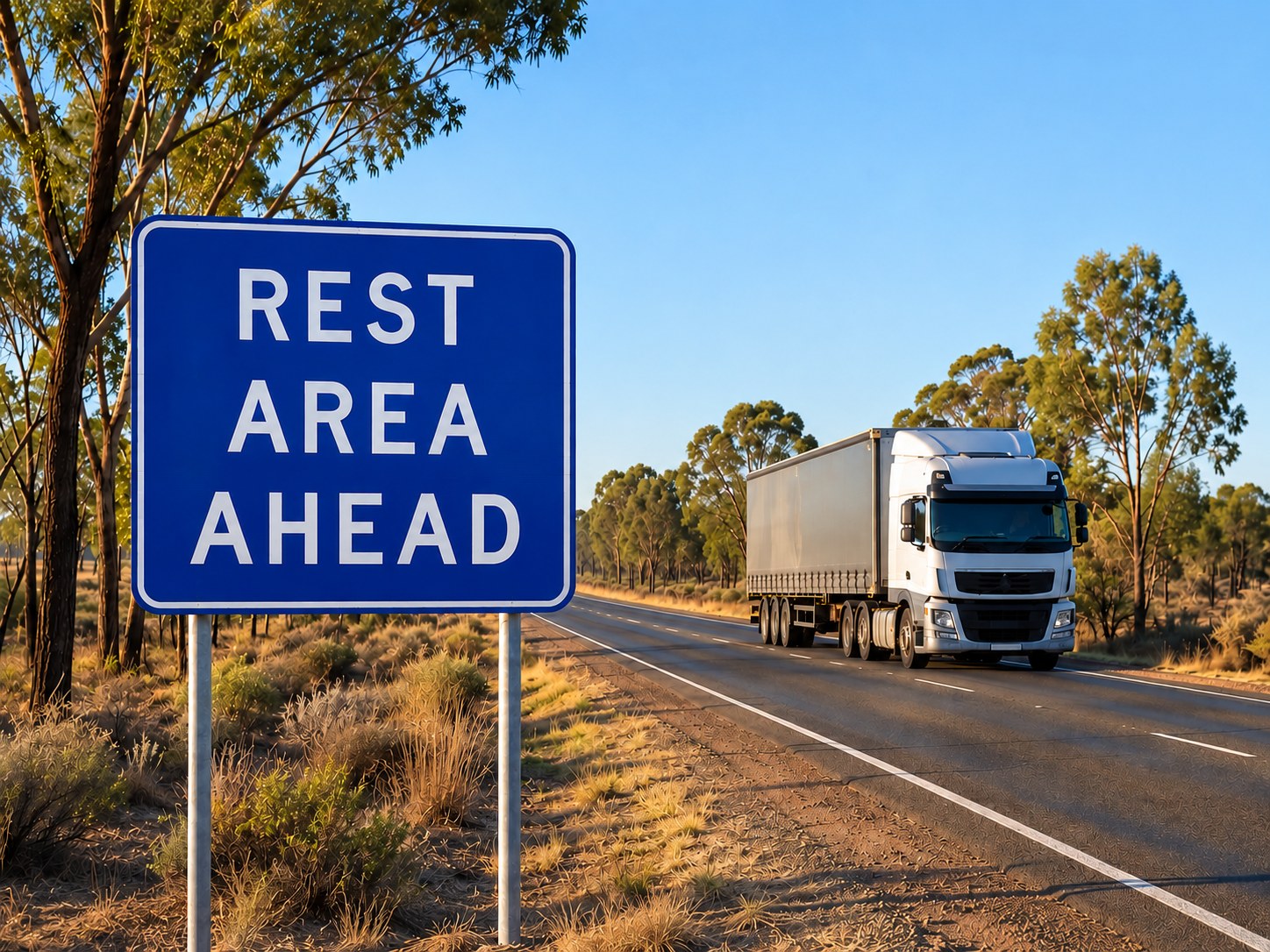
Counting the trucks that travel along a highway is not enough to establish how much rest-area parking that road needs. Nor does a published number of truck bays necessarily tell drivers how many usable spaces are available for the combinations they operate.
That is the central message in a written response provided to Which Way To Go by Austroads on 26 October 2026, following questions about truck rest-area design, demand and the role of telematics data.
Austroads says its research for an update to national heavy-vehicle rest-area guidance looks beyond daily traffic volumes to peak occupancy, stopping duration, seasonal patterns, vehicle types and the dimensions of combinations using a route.
The updated guidelines and supporting research report are still undergoing Austroads approval and have not been published. The comments supplied to WWTG describe the research considerations, not newly adopted design rules.
A parking bay is not necessarily a usable rest stop
Rest-area capacity is often described in terms of the number of trucks that can park. Austroads says that figure needs to be tested against the vehicles actually operating on the corridor.
A site can have a nominal number of spaces but still lack adequate usable capacity for larger combinations, including vehicles operating under Performance Based Standards (PBS) or oversize/overmass (OSOM) arrangements.
The research considers the largest heavy vehicles expected on a route, and the room those vehicles need to enter, turn and leave safely. That includes swept paths — the space occupied by a vehicle and its trailers as they manoeuvre.
The distinction matters when a driver arrives at a rest area with a combination too long for the marked spaces, or cannot get into a nominally available bay without obstructing another vehicle. The total painted on a plan may differ from the number of spaces practically usable by a particular vehicle.
When do drivers actually need to stop?
According to Austroads, adequate parking has to be available where and when drivers need it. A daily count of passing heavy vehicles does not show how many require a rest at the same time, how long those vehicles occupy spaces or how demand changes over a season.
The distinction is especially important for overnight stops, where the available capacity at the busiest time may be more relevant than a daily average. It also raises a question for project assessments: how is the expected number of vehicles stopping at a site distinguished from the number simply passing it?
Austroads’ current published rest-area guidelines date from 2019 and already cover assessing need, site capacity, bay dimensions and accommodation of larger vehicles. Austroads’ current update project, NEF6436, also identifies improving access to rest-area utilisation data as one of its objectives.
Can telematics show where parking is missing?
De-identified telematics information could help road managers understand where heavy vehicles stop, when they arrive and how long they remain there, Austroads told WWTG. It may also reveal stopping patterns at informal locations that do not appear as conventional signed rest areas.
But the organisation cautioned that telematics currently covers only part of Australia’s heavy-vehicle fleet. It is therefore better suited to identifying demand patterns than giving a complete, real-time count of parked trucks.
Austroads says understanding unmet demand may require telematics to be combined with other evidence, such as parking sensors or camera-based occupancy monitoring. A road manager would need to account for vehicles missing from the telematics sample rather than assume the data represents every truck using a location.
That is a practical distinction for governments investing in new facilities: knowing where trucks have stopped is useful, but it is not automatically the same as knowing where drivers tried to stop and could not find a suitable space.
Camber can matter when the cab is the bedroom
Austroads is also considering how level a rest-area surface should be for drivers who sleep in their vehicles. Roads and parking areas need drainage, but excessive crossfall or camber can affect comfort in a sleeper berth, it says.
Driver advocate Rod Hannifey raised concerns with WWTG about the camber at the upgraded Tycannah Creek rest areas near Moree and Spring Creek north of Narrabri in New South Wales. He has questioned whether the finished surfaces suit drivers resting in their cabs.
Those concerns remain unverified site-specific claims, not findings of a design defect. WWTG has asked Transport for NSW for the approved or completed layouts, bay dimensions, crossfall specifications and vehicle types the facilities were designed to accommodate. The department acknowledged the enquiry and was given until 4 November to respond.
The Austroads response does not assess either site. It does, however, confirm that sleeping comfort and the suitability of spaces for the combinations using them are legitimate considerations in rest-area research.
Investment brings a test of outcomes
On 2 September, the Australian Government announced more than $9 million in funding for another group of heavy-vehicle rest-area projects across four states. It said more than $59 million had been committed to new and upgraded sites under the initiative at that time.
New parking and better amenities can improve rest opportunities. The question raised by the Austroads research is how agencies establish whether a proposed design matches the actual peaks in demand and the vehicles needing to stop — and how they assess that match once a facility opens.
WWTG is continuing to seek project-level evidence from road agencies, including parking dimensions, before-and-after capacity, occupancy and design records. Those answers are needed before drawing conclusions about whether particular upgraded sites have gained or lost usable capacity.
Austroads says its revised guidelines and supporting research will be made public after approval. Until then, the response supplied to WWTG sets out an important test for any rest-area announcement: not simply how many spaces are promised, but how many suitable places to rest will actually be available when drivers need them.