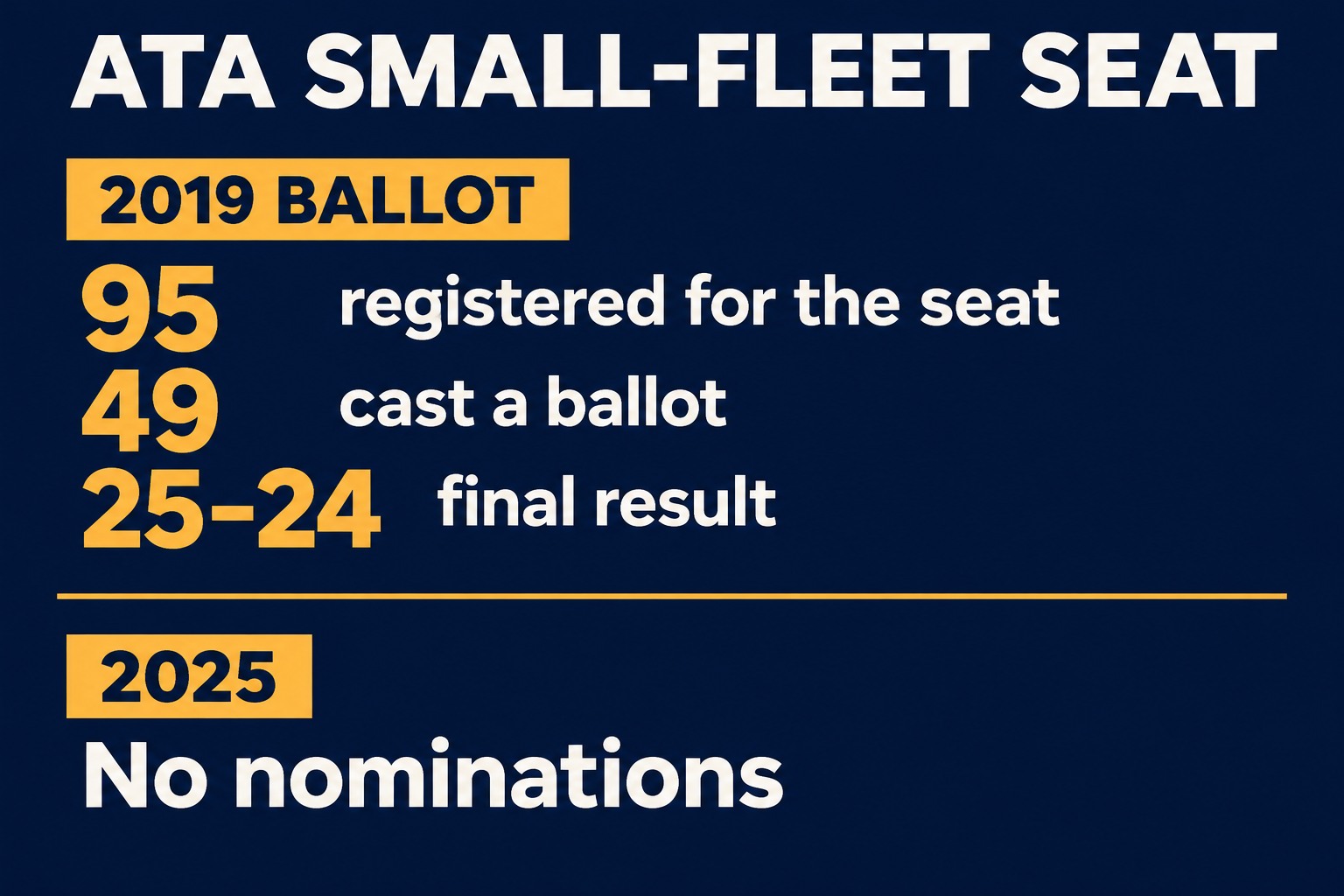
In 2019, 49 of the 95 registered electors for the Australian Trucking Association’s small-fleet seat cast a ballot. Angela Welsh won it 25–24. In 2025, nobody nominated for the seat. As registrations open for the 2027 election, the ATA has confirmed to Which Way To Go that the seat is vacant and Welsh holds the separate owner-driver seat. 2019 result · 2025 declaration
How big is the group the seats are meant to represent?
The Australian Bureau of Statistics counted 65,225 road freight transport businesses in June 2025. A Queensland government analysis, drawing on older industry research, puts the share operating one truck at about 70%, with a further 24% operating two to four. Applied to the ABS count, that gives a rough sense of scale: about 46,000 one-truck businesses and 16,000 with two to four trucks. ABS business counts, data cube 2 · Queensland impact analysis
That is not an estimate of eligible voters. The fleet-size split is older than the ABS count, it doesn’t isolate five-truck fleets, and it doesn’t establish which trucks are over 4.5 tonnes or which operators meet the ATA rules. The 52% turnout in 2019 was among the 95 electors on that seat’s roll. What we don’t know is how many operators qualified to enrol in the first place, or what share of them did.
You can vote without joining. You can’t stand without joining.
An eligible operator with one to five trucks over 4.5 tonnes can register to vote for free without joining an ATA member association. To stand, an operator must be on the roll and belong to a member association. A candidate for the one-truck seat must also drive that truck. 2027 ATA election rules
WWTG asked why membership is needed to stand but not to vote, how many operators meet the extra requirement, and how many have registered for 2027. The ATA did not answer those questions in its reply. It did say the positions are unpaid, agreed travel and accommodation can be covered, and most internal meetings offer an online option. The nomination fee has fallen from $80 to $20. Those changes can make it easier to take part; they don’t change who is allowed to stand.
Who speaks for operators outside the member associations?
A vacant elected seat doesn’t mean small fleets have no advocates. It does mean there’s currently no one in the seat set aside for their elected representative. The ATA’s rules allowed the council to appoint someone after nobody nominated in 2025; its reply did not say whether anyone held the seat in the interim. Employed drivers, meanwhile, don’t qualify to vote on the basis of employment alone and have no dedicated seat in this election. We asked the ATA who brings their views to council. That also remains unanswered.
The numbers that would let operators judge the system are straightforward: how many qualify to vote, how many are enrolled, how many qualify to stand under the membership rule, and how many actually vote. Until those figures are available, we know how close one contest was and that the next drew no small-fleet candidates. We don’t know how much of the industry either outcome represented.
Register to vote · Nominations open 5 February 2027. Both close 5 March at 5 pm AEDT (4 pm Queensland).
Read more: What the role involves and how to stand, at Australian Custom Trucks.