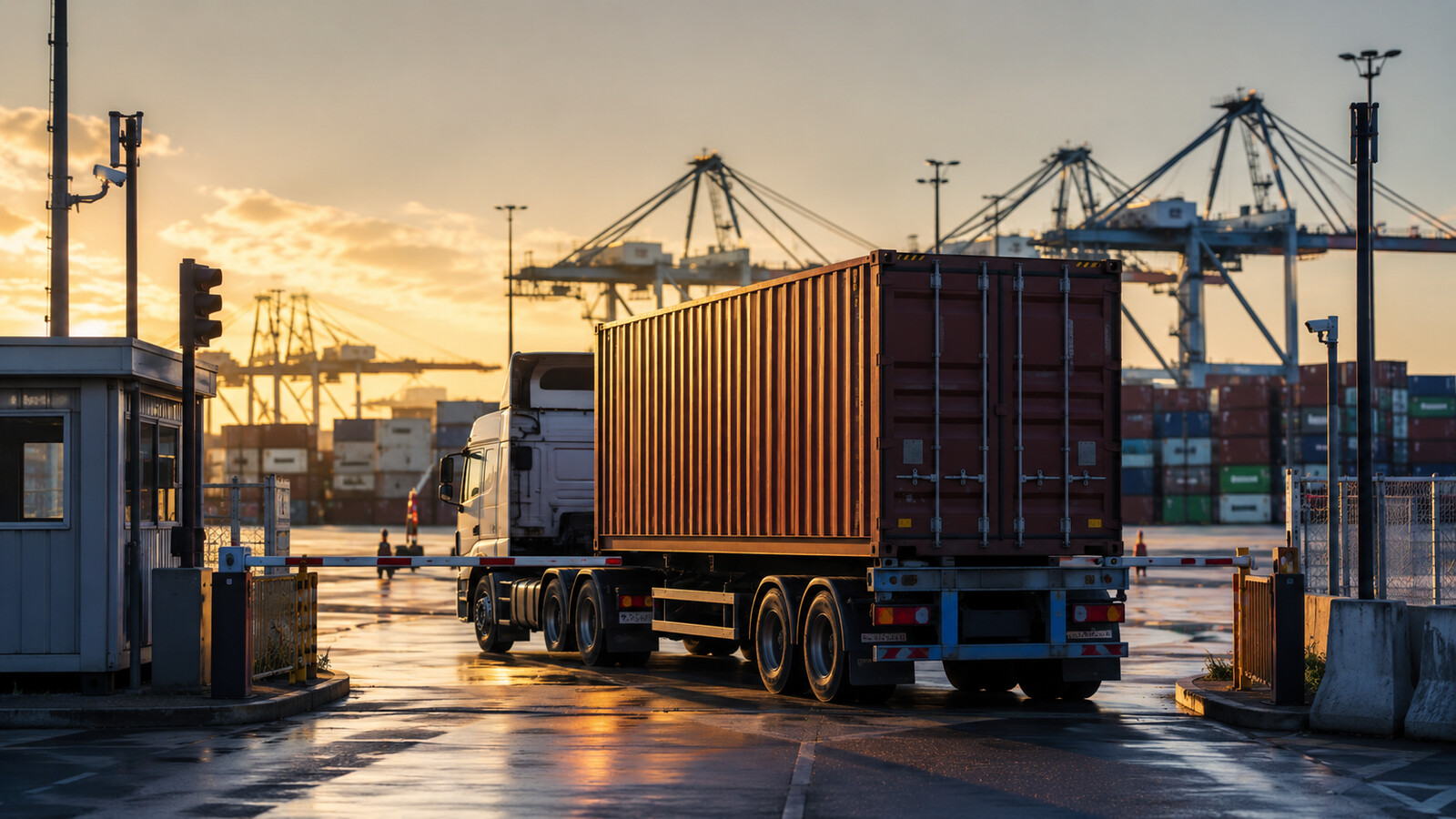
forced transaction: pay a rapidly escalating terminal access fee, or leave your cargo on the dock. Driven by port privatisations, fierce competition for ocean shipping lines, and unchecked monopoly power at the gate, landside terminal charges at Port Botany have ballooned beyond $225 per container in 2026. While stevedores cite necessary infrastructure investments and ocean carriers claim it isn’t their problem, cargo owners are left staring at an unresolved question: why are they being forced to pay for a service they never negotiated?
At Port Botany, Patrick Terminals’ published import landside charge rose to $224.90 for a full container on 1 January 2026. From 1 April, DP World Sydney’s equivalent terminal access charge reached $225.51.
Those figures explain where Australia’s container freight system is now. They do not explain how it got here – or settle the argument over whether anyone with the power to change it should.
None of the parties interviewed argued that stevedores should be prevented from charging for access or genuine landside services. Shipping Australia’s position is that the right to charge for access flows from ordinary property rights. Nor is every fee on a transport operator’s invoice illegitimate: booking, late-arrival and no-show charges can be part of making scarce terminal capacity work.
The harder question is narrower and more difficult to wave away. A fixed price is imposed on the one party in the chain that did not select the terminal, cannot negotiate the rate and cannot obtain the nominated container anywhere else. Governments have so far responded by improving notice and transparency, even after a national inquiry recommended enforceable oversight.
The warning before the charge
Dr Stephen King, who presided over the Productivity Commission’s inquiry into Australia’s maritime logistics system, says the commercial reality at the terminal gate is blunt: “If you want to pick up your container, you’ve got to pay us something – and you’ve got no choice because we’ve got your container. If you want it, you pay it.”
King’s point is not that terminals have no right to recover legitimate costs. It is that a truck or rail operator cannot discipline the price in the usual way. “You can’t say, ‘I’m taking my business elsewhere,’ because nowhere else has your container,” he said. In a two-sided market, he said, a terminal can face pressure from powerful shipping-line customers while recovering revenue from the less powerful landside side.
That diagnosis sits within a longer history. Addressing the ABARES Outlook Conference in March 2016, then-ACCC chairman Rod Sims argued that treating monopoly pricing as a “simple transfer of economic rents” was ill-conceived, because it removes the incentive for a monopoly infrastructure provider to control its own costs. He later applied that warning directly to port privatisation, including the sale of Port Botany and Port Kembla to a single owner. Dr Greig Taylor, a management researcher at UNSW Business School who has studied Australian container-port reform since privatisation and made submissions to the Productivity Commission’s own inquiry, has found in peer-reviewed research with Dr Matthew McDonald that privatisation has delivered few of its promised efficiency gains, leaving ports as geographically fixed monopolies with long leases and limited substitutes. Those points do not establish that every TAC is excessive. They explain why ownership and investment alone cannot answer the market-power question.
A market with two very different customers
Container terminals have two commercial interfaces whose bargaining positions are not remotely equal. Shipping lines can compare terminals, negotiate service agreements and – subject to route, schedule and port constraints – direct their vessels and cargo elsewhere. A road or rail operator collecting a particular container cannot.
The box is on a nominated ship, handled at a nominated terminal. The transport operator did not make that choice. It turns up, accepts the terminal’s access conditions, pays the published charge and commonly passes the cost to the importer or exporter.
For most of the period in which the Australian Competition and Consumer Commission has monitored container stevedoring, beginning in 1998-99, the bulk of stevedore revenue came from the negotiable side of that relationship: shipping lines. That began to change markedly from 2017-18, when terminal access charges spread rapidly across the monitored ports.
A similar pattern emerged at empty-container parks, another part of the container chain where users face limited practical alternatives. By the first half of 2024, the highest notification fee in Sydney had risen from $5.50 per container in 2018 to $179.40. The ACCC described a leap-frogging pattern in which increases by comparable operators closely followed one another.
Neil Chambers of the Container Transport Alliance Australia argues that the mechanism behind the stevedore charges is straightforward. “The shipping lines charge their import-export customers … port fees,” he said, describing the terminal handling charge, or THC, traditionally billed by shipping lines to recover terminal-service costs.
His view is that landside charges then duplicate part of that service. “My suggestion to people – and people’s eyes glaze over even when I say this to bureaucrats and the like – is that the shippers are paying twice for the same service.”
That claim remains contested. No matched set of invoices and contracts — a shipping line’s THC and a transport operator’s TAC for the same container — was supplied to prove that the two charges fund identical work. Chambers also acknowledged that no one had completed a proper analysis showing how any decline in what shipping lines paid stevedores related to the THCs shipping lines charged their customers.
The result is an unresolved transparency problem. Cargo owners can see two charges associated with a terminal movement, but cannot see enough of the confidential contracts or cost allocation to determine where one service ends and the other begins.
How the charges began
There was no single national starting price, and no straight line from a small 2010 fee to today’s charges of more than $200. Patrick introduced an infrastructure charge of $17.75 in Brisbane in late 2010 – a precursor, confined to one port, that did not immediately spread. For several years afterwards, landside charges stayed limited in scale and geography.
The pattern that defines the current dispute began in April 2017, when DP World introduced a $3.45 infrastructure charge at its Melbourne terminal. Patrick and DP World then sharply raised or introduced similar levies at east-coast terminals, and Hutchison and VICT followed. By 1 July 2018, every stevedore at every terminal the ACCC monitors was charging one. The escalation was rapid: the ACCC recorded DP World Melbourne’s own charge rising from $3.45 in April 2017 to $85.30 by January 2019.
The timing was not incidental. Through the mid-2010s, new entry by Hutchison and VICT intensified competition for shipping-line contracts, while consolidation strengthened the shipping lines’ own purchasing power. That competition placed pressure on quayside prices, but only on the negotiable side of the terminal. Landside charges then became the mechanism through which stevedores recovered revenue from the side of the market that could not push back.
Privatisation forms the backdrop rather than the direct cause: Queensland leased the Port of Brisbane in 2010 for $2.1 billion, NSW leased Port Botany and Port Kembla together in 2013 for $5.07 billion, and Victoria leased the Port of Melbourne in 2016 for more than $9.7 billion. None of those transactions set a terminal access charge. What they did was elevate the value of the underlying monopoly assets and, in the case of Botany and Kembla, place potential competitor ports under one owner – the outcome Rod Sims later pointed to when he warned that Australian governments had prioritised sale price over long-term competition.
Shipping Australia’s answer: property and separate services
Shipping Australia policy and communications manager Jim Wilson framed the shipping industry’s position as one of principle rather than commercial detail, citing competition-law constraints on discussing specific prices or arrangements.
“Stevedores, who operate container terminals, have an inherent right recognised by law to charge for access to their property,” Wilson said. “It is an inherent right of ownership.”
He compared the two sides of a terminal with separate services offered by the same business: a cinema ticket and food from the concession stand, or different classes of vehicle entering a distribution centre. In his account, the shipping line buys marine-terminal services, while road and rail operators buy landside access and supporting infrastructure.
On why the charge falls on transport operators instead of being folded into what stevedores bill shipping lines, Wilson’s answer was pointed. Shipping lines have their own costs to bear, he said, and transferring a transport operator’s input cost to an unrelated party would be burden shifting rather than reform.
Asked whether Shipping Australia supported a mandatory national code with ACCC oversight, Wilson said the dispute sat outside the ocean shipping industry’s role and was “literally none of the ocean shipping industry’s business”. In Shipping Australia’s view, it should be addressed between terminal operators and transport operators. Its central concern was that costs properly belonging to other industries should not be transferred to shipping lines.
Wilson nevertheless acknowledged a crucial distinction. If a business were earning unusually high profits or extracting economic rent because of monopoly or oligopoly conditions, he said, that could justify targeted government intervention in the public interest. Such intervention should regulate the affected market directly rather than move the cost to a third party.
That concession narrows the argument. The question is not whether property rights disappear at the terminal gate. It is whether those rights alone provide sufficient price discipline when the person receiving the invoice had no role in choosing the supplier.
Hapag-Lloyd’s response: negotiation with constraints
Hapag-Lloyd accepted that it negotiates Australian stevedoring and terminal-service arrangements, but said price is only one factor. Berth-window availability, terminal productivity and other operating constraints also shape the choice.
It also disputed any suggestion that a dissatisfied shipping line can simply move to another terminal. Most Australian services operate through vessel-sharing agreements, Hapag-Lloyd said, so all participating lines must agree to a move and a suitable berth window must be available.
That qualification makes the contrast less absolute without making the two sides equivalent. A shipping line may face real contractual and operational limits, but it participates in negotiations over terminal services. The road or rail operator collecting the nominated container does not choose the terminal or bargain over the published TAC.
Hapag-Lloyd would not endorse the proposed causal link between lower waterside prices and higher landside charges, saying the terminal-operator and transport-operator relationship was a matter for those parties. It said TACs are levied on transport operators and any later pass-through depends on their arrangements with customers.
On regulation, Hapag-Lloyd said it hoped disputes would be resolved voluntarily, but noted that the Productivity Commission had identified market power in the terminal-operator and transport-operator relationship and recommended regulating how terminals charge transport operators. Government intervention, it said, should follow demonstrated market failure, be effective and avoid unintended consequences.
Patrick’s response: investment, resilience and partial cost recovery
Patrick Terminals’ response sets out the stevedore case for the charge in more detail. Rather than answer the questions individually, it referred this story to its published 2026 charges notice and landside performance information.
The notice says landside charges are initially paid by transport operators and then recovered from shippers. It says the charge partially recovers capital investment and commitments to infrastructure, as well as maintenance, operational and property-related costs.
Patrick says it invested more than $400 million across the previous six years. It argues that this investment builds resilience and allows it to absorb unexpected cargo shifts, pointing to more than 200,000 containers it says moved through Patrick without disruption during industrial action affecting a competitor.
The operator says landside and ancillary charges remain well below half its overall revenue, that property and energy costs have risen above CPI, and that it only partially recovers its investment and operational costs through the landside charge. It supports formalisation of the enhanced National Voluntary Guidelines being developed through the National Transport Commission.
Patrick did not directly answer questions about whether transport operators are captive customers, whether the increases reflect an exercise of market power, or whether proposed increases should be independently testable under a mandatory ACCC-administered code.
NSW Ports’ response: landlord role and investment
NSW Ports said it has no role in stevedore pricing. It said the three stevedores’ rents are governed by leases entered into more than a decade ago and have increased by CPI since then.
The port owner also pointed to substantial landside investment: $120 million for four 600-metre sidings within Patrick’s terminal, a further $148 million committed for four sidings at DP World’s terminal, more than $9 million spent on Simblist Road over six years, and $17 million on new empty-container parks. It said estimated empty-container capacity at Port Botany had increased about 26 per cent since 2020 to 76,100 TEU.
Those figures are relevant to the industry’s argument that access charges sit within an infrastructure-intensive system. They do not show how an individual stevedore allocates landlord, terminal and network costs to its TAC, or whether a particular increase reflects cost recovery, market power or both.
What the numbers actually show
The Productivity Commission’s final report, released in January 2023 after its 2022 inquiry, found that transport operators have no practical choice of terminal for a nominated container and must accept the operator’s terms.
King said the Commission’s concern was the ability to move revenue to the side of a platform with the least bargaining power, not simply whether an operator’s total profit rose. The inquiry’s conclusion therefore went beyond the label attached to the invoice: it examined the structure of the waterside and landside markets and the absence of a practical alternative for the nominated box.
It modelled TAC revenue at roughly $482 million by applying 2022 charge rates to 2020 container volumes. That is a different measurement, using a different methodology, from the ACCC’s later monitored revenue and should not be treated as the same figure.
The Commission recommended a mandatory national code under Part IVB of the Competition and Consumer Act, administered by the ACCC. Its model would limit price changes to once a year, require baseline information and justification for increases, and allow regulatory review. It was not a proposal to abolish the charge, but to create a circuit-breaker against unreasonable pricing.
That distinction captures the difference between information and accountability. A transport operator can be told in advance that a charge will rise, but under the voluntary guidelines it cannot ask an independent party to test whether the increase is justified, and it cannot vote with its feet in the way a normal customer can. Freight & Trade Alliance, which represents freight forwarders and, through the Australian Peak Shippers Association, major exporters, was approached for comment on the code and on its preferred alternative of redirecting landside charges to shipping lines. It did not respond by deadline.
Significantly, the Commission stepped back from simply redirecting fixed charges to shipping lines. It warned that the same revenue could reappear in booking, slot or incentive-based fees. Changing the name on the first invoice would not necessarily change who ultimately carried the cost.
The mandatory code was not implemented. The National Voluntary Guidelines for Landside Stevedore Charges, introduced in 2022, remained the operating framework.
In the years that followed, the figures the Commission had warned about arrived. The ACCC’s 2024-25 monitoring report recorded real industry revenue of $423.11 per container lift, industry EBITDA of $808.6 million, an EBITDA operating margin of 34.8 per cent and a 45 per cent return on average tangible assets.
TAC revenue exceeded $642 million for the year, with more than $3 billion collected since the significant increases began in 2017. Landside and other revenue reached $1.15 billion, or 49.5 per cent of total industry revenue – roughly matching the revenue collected from shipping lines.
Those are industry-wide figures. They do not prove that every charge at every terminal is excessive, nor do they erase the industry’s investment. The ACCC recorded approximately $1.25 billion in aggregate stevedore investment over the previous eight years. Terminals require cranes, pavement, automation, rail interfaces, gate systems, safety measures and spare capacity if the freight network is to withstand disruption.
But high returns, rising real prices and significant spare terminal capacity also make it harder to argue that ordinary competitive pressure is constraining landside prices.
An ACCC spokesperson, confirming this story could rely on the regulator’s published data, said its latest report “indicates that government policy or regulatory action may be needed to address market issues and improve Australia’s container freight supply chain for households and businesses.”
Two tracks, only one capable of moving beyond transparency
In August 2025, transport ministers responded along two separate paths.
The first asked the National Transport Commission to update the voluntary guidelines. The proposed changes would align stevedore price increases to a single annual date of 1 January and extend similar requirements to empty-container-park operators.
A federal infrastructure department spokesperson said the change “provides more certainty for business and consumers”. The NTC said its consultation closed on 13 March 2026 and the updated guidelines are proposed to commence on 1 January 2027, subject to approval by transport ministers.
That process addresses a genuine operational problem. A consistent annual date and adequate notice help carriers price contracts, communicate with customers and avoid multiple unplanned adjustments during the year. It improves predictability and transparency.
It does not make a price increase reasonable, give the payer power to reject it or create independent review of its justification.
The second track is the one capable of engaging with the ACCC’s market warning. Ministers separately agreed that the Infrastructure and Transport Senior Officials’ Committee would establish a working group to explore options and recommend next steps in response to the ACCC’s findings concerning stevedore charges.
The department said the working group first met on 15 May 2026, chaired by Freight Victoria, with the ACCC presenting its findings.
On 17 August, after being asked whether ministers had approved the updated guidelines, whether the working group had met again or set a reporting timetable, and whether the Australian Government had formed a position on enforceable oversight, the department confirmed that its 4 August response still stood. Neither the department nor the NTC directly answered whether the government accepts the Productivity Commission’s market-power finding, whether it supports the recommended mandatory code, or whether the voluntary guidelines will be treated as sufficient.
That distinction is the policy heart of the story. Transparency tells a captive payer when the bill will rise. It does not let that payer say no – or ask an independent decision-maker whether the increase is justified.
The unresolved question
None of the parties approached argued that terminals should be unable to charge for their services. The disagreement is over whether a customer with no ability to shop around or negotiate should be able to have an increase independently tested – and by whom.
The Productivity Commission answered that question in 2023 by recommending an enforceable national code. Governments have since proposed a common annual date for price changes and opened a second, broader reform process. As of 17 August 2026, they had not resolved whether those increases would become contestable.
Patrick Terminals referred to its published charges notice and landside performance information rather than answering the questions individually. Hapag-Lloyd provided a substantive response after the original deadline. Maersk respectfully declined to comment or participate. CMA CGM/ANL acknowledged receipt through an automated customer-service response but did not provide substantive comment. MSC and Ocean Network Express did not respond. DP World Australia and Victoria International Container Terminal did not provide substantive responses. NSW Ports provided a written response on its landlord role, rent arrangements and landside investment.
The charge has a legal and commercial foundation. What remains unresolved is whether that foundation is enough when the payer has no ordinary market check on the price.
The box has not changed. The bargaining power around it has – and Australia’s transport ministers are still deciding whether to hand any of it back.
This account draws on the ACCC’s 2024-25 container stevedoring monitoring report, the Productivity Commission’s final report into the Australian maritime logistics supply chain, the National Transport Commission’s review of the national voluntary guidelines, and the Infrastructure and Transport Ministers’ Meeting communique of 11 August 2025. It also draws on written responses from Patrick Terminals, Hapag-Lloyd, NSW Ports, the ACCC, the federal infrastructure department and the NTC; interviews with Dr Stephen King, the Container Transport Alliance Australia and Shipping Australia; and public research and commentary, including Rod Sims’ March 2016 ABARES address and Dr Greig Taylor and Dr Matthew McDonald’s peer-reviewed research on Australian container-port reform. Freight & Trade Alliance was approached for comment and did not respond by deadline.