A truck is intercepted and a compliance problem is found. Does the matter end with the driver and vehicle — or can it lead the regulator back through the operator’s entire safety system? The NHVR has clarified where the roadside inspection ends and broader scrutiny of the business can begin.
A truck is intercepted. An officer finds a compliance problem.
Does the matter end with the driver and vehicle — or can it lead the regulator back through the operator’s entire safety system?
That distinction has become more important since the amended Heavy Vehicle National Law commenced on 1 August 2026 and the industry began its transition from the National Heavy Vehicle Accreditation Scheme (NHVAS) to the new Heavy Vehicle Accreditation (HVA) framework.
The National Heavy Vehicle Regulator has now clarified that boundary for Which Way To Go.
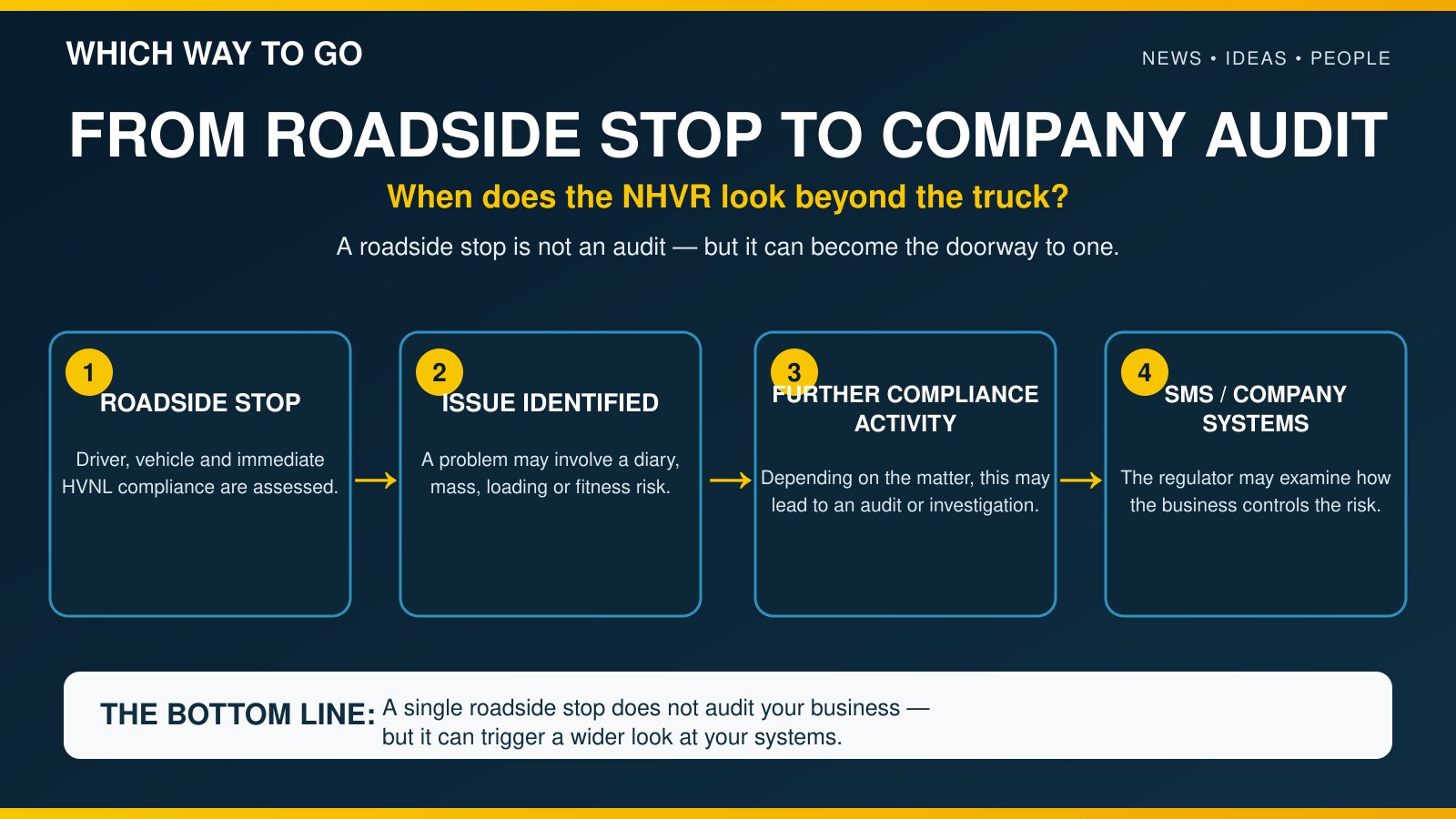
A roadside intercept remains primarily an assessment of the driver, vehicle and immediate compliance. It is not a comprehensive audit of the operator’s Safety Management System.
But if what is found roadside leads to further compliance activity, such as an audit or investigation, the regulator says the operator’s SMS may then be examined to understand how the business identifies, manages and controls the underlying safety risk.
Put simply: the roadside problem can become a systems problem.
The roadside is still the roadside
The NHVR told WWTG:
“A roadside intercept is primarily focused on assessing the driver, vehicle and immediate compliance with the HVNL.”
That is an important boundary.
An organisation-wide Safety Management System can include documents, processes, competencies, risk controls and management systems extending far beyond what an individual driver could demonstrate beside a truck.
The regulator says a roadside interception therefore cannot provide a comprehensive assessment of an operator’s SMS.
That means a roadside stop should not be confused with an audit of the business.
But it does not mean what happens roadside necessarily stays there.
When the lens widens
The significance changes when something identified during the interception warrants further regulatory attention.
The NHVR told WWTG that where roadside compliance concerns lead to further activity, such as an audit or investigation, the operator’s Safety Management System may then be examined.
The purpose can be to understand how the business identifies, manages and controls the safety risk involved.
That creates a useful distinction for operators:
A roadside interception provides a snapshot. An audit or investigation can examine the system behind that snapshot.
The question can therefore move from:
Was this driver and truck compliant?
to:
How was the business identifying and controlling the risk that produced the problem?
That does not mean every roadside breach will trigger an investigation or company audit.
The NHVR says its response depends on the circumstances of the individual matter and continues to be risk-based and proportionate.
But it does mean the roadside can potentially be the starting point for a much broader examination.
New laws, but not a new enforcement philosophy
There is another important distinction following the 1 August reforms.
The law changed.
The NHVR says its underlying approach to enforcement did not.
The amended HVNL introduced changes across areas including work diaries, fitness to drive, mass, dimension and loading requirements and accreditation.
Safety and Compliance Officers are enforcing those requirements as they now stand.
But the regulator told WWTG its established “inform, educate and enforce” approach remains in place.
It continues to describe its regulatory approach as risk-based, proportionate and consistent.
That should also kill off two potentially misleading interpretations of the reforms.
The first is that 1 August ushered in an entirely new roadside enforcement regime. The NHVR says it did not.
The second is that the transition means enforcement has effectively been suspended while operators learn the new requirements. It has not.
The NHVR says enforcement remains available where information and education have not resulted in changed behaviour, and officers determine the appropriate response according to the circumstances.
What might be different at the roadside?
Although the enforcement philosophy has not changed, some of the rules officers are enforcing have.
The NHVR specifically pointed WWTG to changes involving:
- work diaries;
- fitness to drive;
- mass;
- dimension and loading requirements; and
- accreditation.
For drivers and operators, that distinction matters.
The question is not necessarily whether officers have suddenly been given a completely different roadside mission. It is whether the operation complies with the current version of the law when the truck is intercepted.
Operators therefore need to separate changes to the regulatory approach from changes to the requirements being enforced.
Why the SMS matters more away from the roadside
The shift becomes clearer when the industry’s move from NHVAS to HVA is considered.
Under NHVAS, accreditation audits focused on selected modules such as Mass, Maintenance and Fatigue.
HVA introduces a broader approach to safety management.
Under General Safety Accreditation, an operator must demonstrate an effective Safety Management System covering safety-critical transport activities across its operation.
The Safety Management System Standard 2026 is structured around five areas: Leadership and Commitment; Risk Management; People; Assurance, Monitoring and Improvement; and Safety Systems.
That makes the new framework inherently broader than simply maintaining separate accreditation folders.
The NHVR told WWTG operators should look beyond transferring their existing NHVAS documentation into the new system.
An operator needs to demonstrate that its SMS is appropriate to the operation, actually implemented and supporting the identification, management and continuous improvement of safety risks.
In practical terms, the question becomes less about whether a business can produce a document and more about whether it can demonstrate that the system described in that document actually operates.
NHVAS and HVA are temporarily running together
Existing NHVAS operators are not required to transition immediately.
The NHVR says they can continue operating under their existing accreditation until it expires, subject to the applicable transitional arrangements.
NHVAS and HVA will therefore operate in parallel during the transition.
The regulator says it is taking a phased approach and has provided guidance, tools and information sessions to help operators understand the new framework.
But transition assistance does not remove an operator’s responsibility to comply with the HVNL and requirements already applying to its operation.
The operational takeaway
For drivers, a roadside intercept remains primarily about the driver, the truck and immediate compliance. It is not a comprehensive examination of the company’s Safety Management System.
For operators, however, there is a second layer to consider.
If an immediate compliance concern warrants further investigation, the regulator can potentially move beyond what happened beside the road and examine how the business was managing the risk behind it.
That makes the distinction between incident and system increasingly important.
A single roadside stop does not audit your business. But depending on what is found and what follows, it can become the doorway to a much bigger conversation about how that business manages safety.
Who this applies to
The roadside compliance elements are relevant to drivers and operators subject to the Heavy Vehicle National Law.
The HVA and SMS requirements are particularly relevant to operators entering the new Heavy Vehicle Accreditation scheme and existing NHVAS operators preparing for their eventual transition.
The HVNL applies in Queensland, New South Wales, the Australian Capital Territory, Victoria, Tasmania and South Australia, subject to jurisdictional arrangements and modifications.
Sources & Primary Documents
- National Heavy Vehicle Regulator — HVNL reform implementation
- National Heavy Vehicle Regulator — on-road compliance and enforcement
- National Heavy Vehicle Regulator — NHVAS transition to HVA
- National Heavy Vehicle Regulator — Heavy Vehicle Accreditation scheme
- National Heavy Vehicle Regulator — Safety Management Systems
- National Transport Commission — Safety Management System Standard 2026
Related: The new HVNL is here. What has actually changed at the roadside?
WWTG verification note: Which Way To Go sought clarification directly from the NHVR about how the 1 August HVNL changes affect roadside compliance, when an operator’s Safety Management System can become relevant, the NHVAS-to-HVA transition and the whole-of-business approach under HVA. The NHVR provided substantive responses on 21 September 2026.