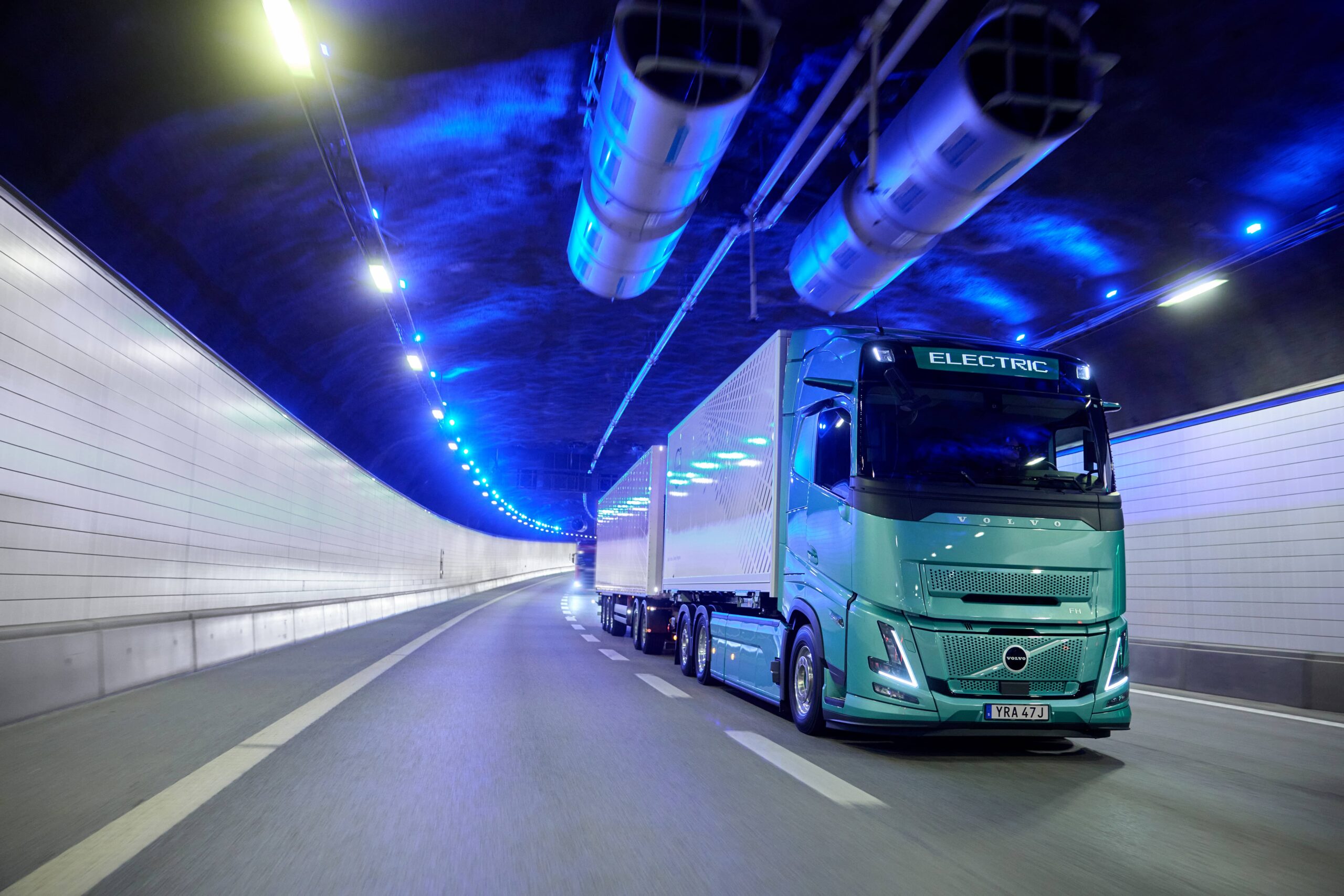
Volvo is now rating a battery-electric FH rigid-and-trailer combination to a maximum gross combination weight of 80 tonnes, moving electric trucks further into work traditionally associated with heavy diesel combinations.
The significance is not that an 80-tonne electric truck has suddenly solved every heavy-haul task. It is that the technical boundary is shifting. Volvo is pairing a much higher combination rating with a 640 kWh usable battery, an electric-specific eight-speed transmission and new hub-reduction axles intended to improve startability and load capacity at high weights.
Volvo quotes up to 450 kilometres of range at 64 tonnes GCW and up to 420 kilometres at 74–76 tonnes GCW. The maximum technical combination rating is 80 tonnes, but Volvo has not published a range figure for operation at that full weight.
The 80-tonne number needs context
A maximum combination rating and a quoted operating range are different specifications. The 80-tonne figure describes the upper technical GCW of the vehicle combination. It does not mean the truck will travel 420 or 450 kilometres at 80 tonnes.
Volvo’s 450-kilometre example is at 64 tonnes GCW. Its 420-kilometre example is at 74–76 tonnes GCW. Actual range will also vary with gross weight, payload, topography, weather, temperature, wind resistance, speed, traffic, auxiliary power use and driving conditions.
That distinction matters operationally. A high technical mass rating establishes what the combination is engineered to handle, but operators still need to know how much usable range remains on a particular route, in the relevant configuration, while carrying a commercially useful payload.
Hardware designed for heavier work
The new FH Electric configuration has 640 kWh of usable battery energy. Volvo says its eight-speed transmission has been developed specifically for electric motors, rather than adapting a conventional diesel driveline around the electric powertrain.
New hub-reduction axles provide greater ground clearance, improved startability at high combination weights and increased technical load capacity. In plain English, hub reduction multiplies torque at the wheels, helping a heavily loaded combination move away from rest while reducing the load carried through upstream driveline components.
Volvo identifies on-road timber transport and lighter construction work among the intended applications. Those examples show the distinction between high-mass vocational work and unrestricted heavy haulage: the truck is aimed at demanding freight tasks, but suitability still depends on the route, body and trailer configuration, axle loads and duty cycle.
An electric power take-off can run equipment such as refrigeration units without a separate diesel generator. That could reduce fuel use, emissions and noise from auxiliary equipment, although it also draws energy from the vehicle and therefore needs to be included in range and charging calculations.
The configuration is available with all Volvo FH cabs except the XXL, including standard FH and FH Aero versions.
Charging becomes part of the freight task
Volvo quotes a 20–80 per cent recharge in about 36 minutes using a 680 kW Megawatt Charging System charger. Using a 360 kW CCS2 charger, the same 20–80 per cent window takes about 70 minutes.
The 36-minute figure is impressive for a battery of this size, but it depends on access to a charger capable of delivering 680 kW. MCS is a heavy-vehicle high-power charging system designed for the energy and turnaround requirements of commercial trucks. It is not simply a slightly faster passenger-car charger.
A 20–80 per cent recharge replenishes 60 per cent of the 640 kWh usable battery—about 384 kWh. Delivering that much energy in a practical freight break requires sustained high power, compatible hardware and a site with sufficient electrical capacity.
Volvo itself says deployment of public MCS charging is only beginning in Europe. This means the truck’s charging time cannot be assessed separately from charger availability, grid connection, queuing, trailer access, depot layout and whether high-power charging is available where a driver and vehicle actually need to stop.
A 640 kWh battery does not solve long-distance productivity by itself. Charging infrastructure, route planning and turnaround time become part of the freight task and part of the vehicle’s productivity calculation.
Why it matters to Australia
Volvo says initial sales will be in Sweden, Norway, Finland, Denmark, the Netherlands and Switzerland, with rollout beginning in early 2027. The company has not announced the model for Australia, and its suitability for Australian operations has not been demonstrated.
Nevertheless, the development is relevant because Australian freight routinely uses high-productivity combinations and high gross combination masses. The question is moving beyond whether a battery-electric truck can physically move a heavy load.
For Australian operators, the practical questions would include payload after accounting for battery and vehicle mass; usable range in heat, wind and varied terrain; access to charging at depots and along freight corridors; the power and reliability of those chargers; route planning; turnaround time; axle and load configuration; road-access approval; and whether local electricity infrastructure can support megawatt-scale charging.
Australia’s long distances and concentrated freight corridors may produce very different results from European duty cycles. Some fixed-route, return-to-base or predictable high-mass tasks may be easier to plan around than irregular long-haul work, but that is WWTG analysis—not a claim Volvo has made for this model.
The boundary is moving
The significant development is not that diesel heavy haulage has suddenly been replaced. The maximum rating does not guarantee a commercially useful payload, sufficient route range or access to the charging power needed to keep the truck productive.
What Volvo has demonstrated in its published specifications is that the technical boundary of battery-electric heavy vehicles is moving into much higher combination weights. Whether that translates into productive Australian freight work will depend at least as much on payload, route, access and charging infrastructure as on the truck itself.
Sources and primary documents
Image: Volvo Trucks