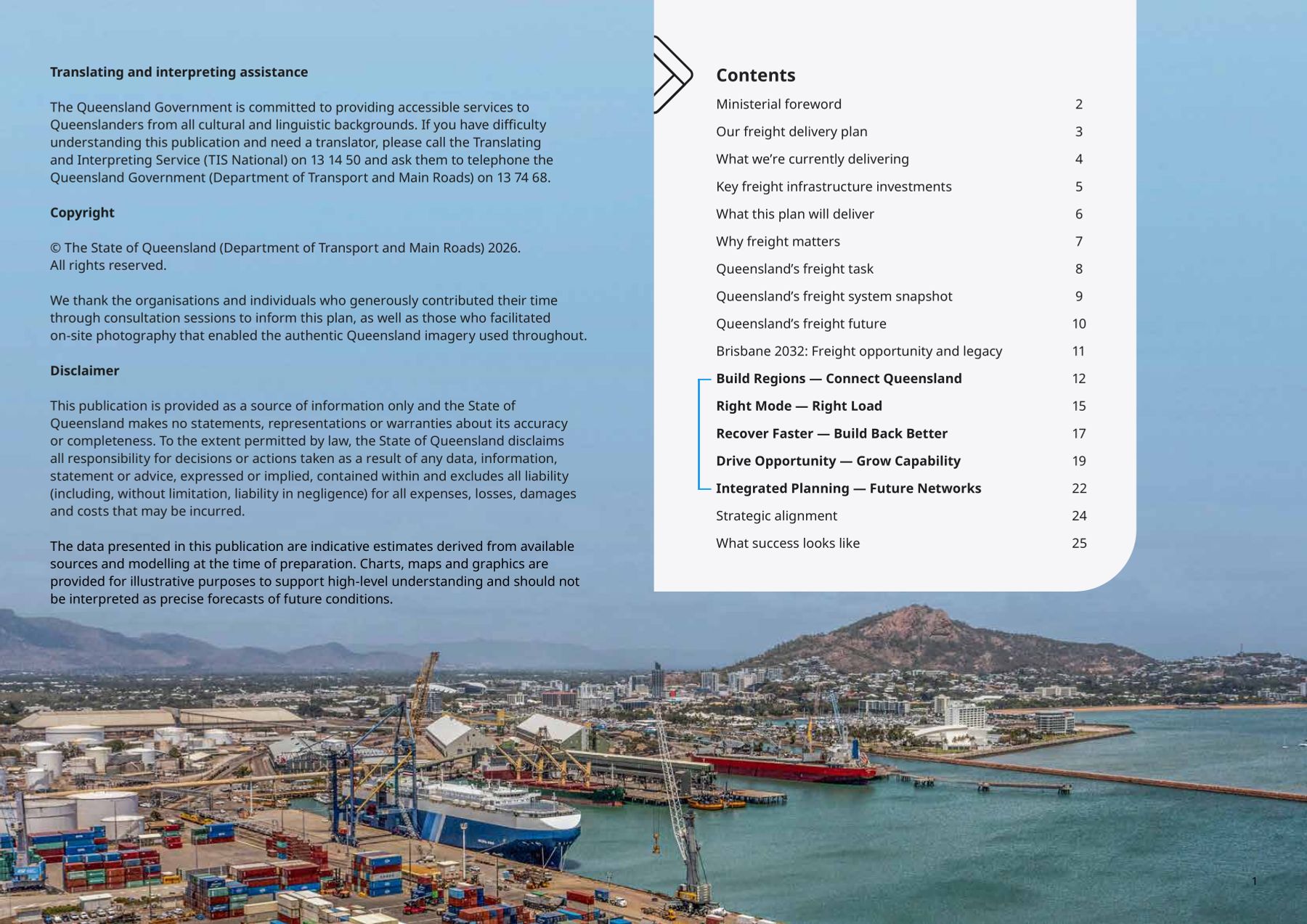
Queensland’s new five-year freight plan includes a rail-container rebate worth up to half of below-rail access charges, reforms to heavy-vehicle access arrangements and new reporting intended to show whether the measures actually improve the network.
The Queensland Freight Delivery Plan 2026 sets out 70 actions across road, rail, ports and remote supply chains as the state’s freight task is projected to grow 20 per cent by 2032.
Its headline rail measure is a new three-year Rail Freight Container Incentive Scheme. It will offer eligible freight customers a rebate of up to 50 per cent of below-rail access charges when they move at least 250 additional twenty-foot equivalent units a year by rail on the North Coast, Mount Isa or Southern Queensland systems.
The plan also commits the state to maintain a 10 per cent Mount Isa Line access-charge subsidy for four years, introduce a discounted diesel-fuel access charge on that line, and retain reduced charges for rock-phosphate freight.
Heavy vehicle access is part of the plan
For road operators, the plan commits to reforming heavy-vehicle access arrangements for productivity and efficiency, including the introduction of the National Automated Access System.
That is not a new NAAS announcement. WWTG has already covered Queensland’s low-loader access preview and the telematics costs TMR has used in its examples. The freight plan matters because it places those access reforms inside the state’s wider productivity program, alongside rest areas, decoupling pads, port connections and freight-corridor upgrades.
Read: Queensland opens NAAS preview ahead of major low-loader access change
Rail capacity and accountability
The plan also calls for targeted work on South East Queensland rail freight capacity, including connections to the Port of Brisbane and the competing needs of passenger and freight services. It proposes new open-access intermodal developments, priority rail and road-corridor upgrades, and a Queensland State of Freight Snapshot with indicators and implementation updates.
Transport Minister Brent Mickelberg said Queensland’s future prosperity depended on moving freight efficiently, reliably and safely. Assistant Minister Sean Dillon said regional industries rely on strong freight connections to get products to market.
The plan identifies the direction of travel, but not every delivery detail. It does not yet set out the container-rebate budget, application process, baseline methodology or whether a movement supported by the state scheme could also receive a Commonwealth TRACK incentive.
WWTG has asked TMR how the state scheme will operate alongside the Commonwealth’s TRACK rail-freight incentive, including who receives the rebate and how overlapping subsidy will be prevented or assessed.