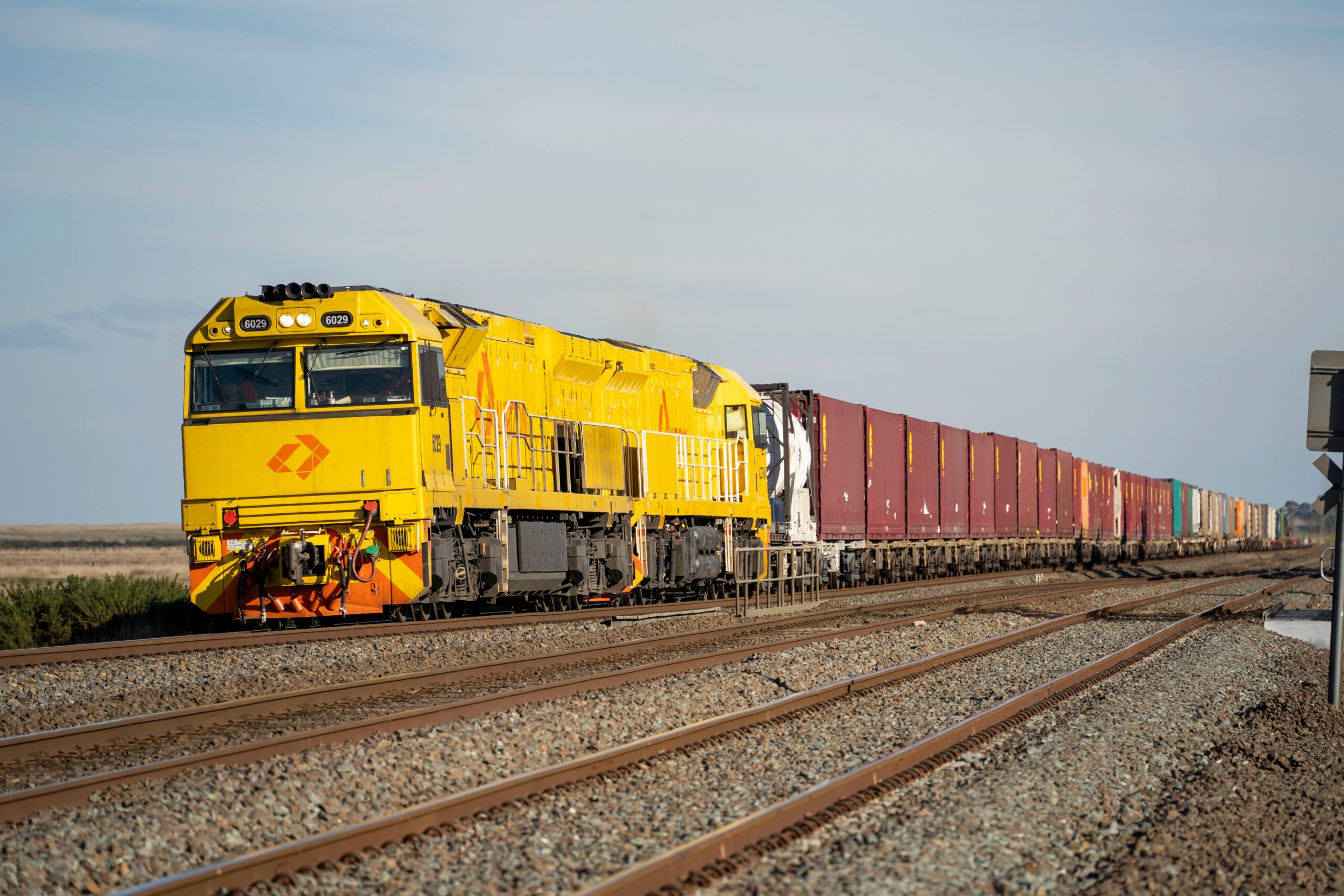
The Federal Government is offering rail freight operators up to $26 million to move freight currently carried by road onto rail — and the detail of the scheme shows this is more than another infrastructure grant.
Round 1 of the Transport Resilience and Capacity Kickstart (TRACK) pilot will make incentive payments to eligible rail freight operators for freight moved above an agreed baseline, with individual applicants able to seek up to $10 million.
The stated objective is to conserve diesel by redirecting existing road freight to more fuel-efficient transport. The pilot will also test whether paying incentives per twenty-foot equivalent unit, or TEU, can produce a rapid shift between freight modes.
It is paying for additional freight, not simply building rail
That distinction matters.
TRACK is not simply funding a new terminal, siding or piece of track and hoping additional freight follows. The grant material says eligible operators can receive an incentive payment for eligible freight moved by rail above an agreed baseline during the project period.
To qualify, applicants must be rail freight businesses registered with the Office of the National Rail Safety Regulator and meet the scheme’s other eligibility requirements.
Eligible projects must carry at least one loaded TEU above the accepted baseline between 1 July 2026 and 30 June 2027, and the additional movements must be capable of verification through grant-agreement evidence, audit and reconciliation requirements.
Diesel saving carries half the assessment
The assessment criteria make the fuel-security objective particularly clear.
Half of the available assessment points are allocated to how a project saves diesel in Australia. A further 35 points assess alignment with the program’s purpose, objectives and outcomes, while 15 points consider how the project improves rail freight resilience over the longer term.
The Commonwealth says the broader $52 million TRACK program sits under the National Fuel Security Plan. Round 1 provides up to $26 million for rail. The Department says subsequent rounds will consider both maritime freight—including shipping and ports—and rail freight.
The Department of Infrastructure says reducing diesel consumption has become critical because of conflict in the Middle East and the resulting pressure on fuel security and supply chains.
The unanswered commercial question
The policy case for using less diesel is straightforward. The more complicated issue is what happens commercially when government pays one freight mode to attract freight from another.
The grant material explicitly describes the objective as supporting the redirection of existing road freight transportation to more fuel-efficient modes, with a focus on financially incentivising rail operators to increase capacity and utilisation.
That raises questions for freight customers and road operators.
Will an incentive allow a rail operator to offer a lower freight rate to a customer considering a switch from road? If so, how much of the public subsidy reaches the freight customer? How will government distinguish freight genuinely shifted from road from rail volume that might have grown anyway?
Those questions do not mean the scheme lacks merit. They matter because TRACK is expressly a pilot designed to generate evidence for future rounds.
Rail says commercial barriers are real
The Australasian Railway Association has welcomed TRACK, arguing the recent fuel crisis demonstrated the value of moving more freight by rail.
ARA chief executive Caroline Wilkie said freight customers make decisions using the whole supply chain, including cost, reliability, service and transit time, and said incentives could help address commercial barriers that prevent customers shifting freight to rail.
The association also argues incentives alone will not be enough, calling for measures that improve rail productivity, reliability, network capacity and technology.
A bigger freight-policy experiment
Infrastructure Minister Catherine King says moving more freight onto rail and sea can reduce congestion, improve road safety, lower fuel reliance and emissions and make supply chains more resilient.
The government says Australia’s national freight task is projected to grow 26 per cent between 2020 and 2050.
TRACK therefore has implications beyond the immediate fuel-security response. If the pilot demonstrates that a per-TEU payment can rapidly change freight-mode decisions, it gives government evidence for a policy mechanism that could be used again.
If it does not, the program should also reveal something useful: whether the barriers keeping contestable freight on road are really price, or whether reliability, transit time, terminal access, service design and network capacity matter more.
What WWTG has asked
WWTG has sought further information from the Department of Infrastructure about how baselines and payments will be set, how genuine road-to-rail shifts will be verified, how results will be reported and whether the financial benefit is expected to flow through to freight customers.
WWTG has also sought views from road-freight and logistics representatives on the competitive impact of the scheme and whether the fuel-security response treats road and rail operators differently.
This story will be updated when those responses are received.
Applications are already open
Round 1 opened on 11 September and applications close at 5pm AEST on 1 October 2026.
Projects must be completed by 30 June 2027. Applicants can seek up to $10 million, with the round offering up to $26 million in total.
View the official TRACK Round 1 grant details and application information on business.gov.au.
For the broader policy and program background, see the Department of Infrastructure TRACK program page.
Reporting note: WWTG checked the Commonwealth’s TRACK program page, the Business Grants Hub grant listing and assessment criteria, the Infrastructure Minister’s 11 September announcement and the Australasian Railway Association’s response. The story distinguishes the confirmed program rules from questions WWTG has put to government and industry. The featured photograph is a representative Australian intermodal freight train and is not presented as a TRACK-funded service.