What happened to Concessional Mass Limits?
Short answer
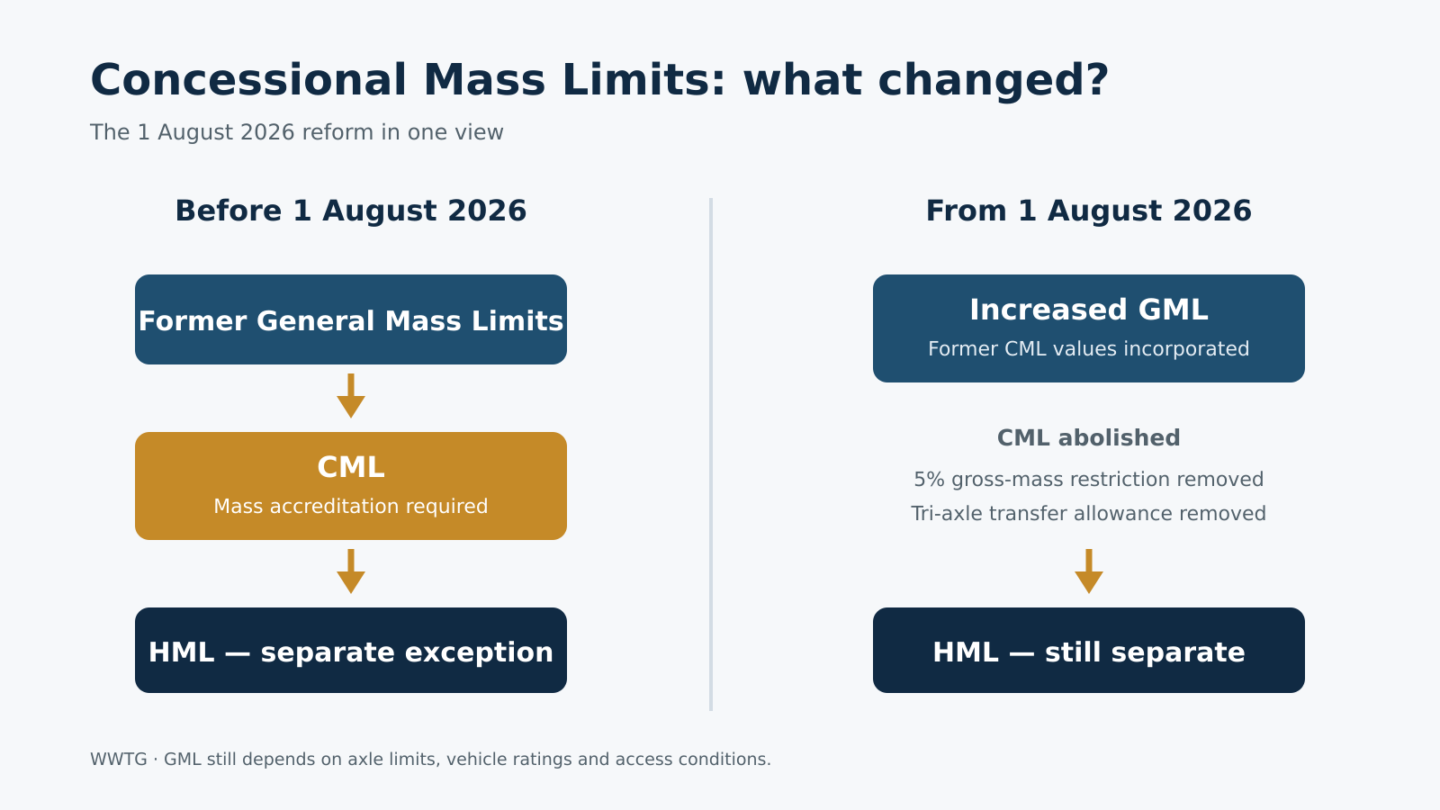
Concessional Mass Limits (CML) were abolished on 1 August 2026. Their former mass values were incorporated into General Mass Limits (GML), so an operator no longer needs the relevant mass accreditation merely to use those former CML weights.
Plain English
CML are no longer a current mass category. Before 1 August 2026, CML generally allowed eligible vehicles operating under mass-management accreditation to carry more than the former GML. The 2026 reforms raised GML to align with former CML values and removed the separate CML framework. The current MDL National Regulation identifies GML in Schedule 1; CML was removed from the list of mass exceptions and the former CML schedule was omitted. An operator does not need the relevant mass accreditation under the Alternative Compliance Accreditation (ACA) framework simply to operate at mass values that were previously CML.
What this means operationally
The reforms also removed the former 5% gross-mass restriction and the one-tonne tri-axle mass-transfer allowance. They are not a blanket increase for every vehicle: applicable Schedule 1 limits, axle and axle-group limits, axle spacing, manufacturer-rated GVM/GCM and component limits, vehicle configuration, road restrictions, access status, route conditions, load distribution and restraint still control.
Who it applies to
Operators, drivers and PBS participants using vehicles subject to the HVNL mass framework in participating jurisdictions.
Example
An eligible six-axle prime mover and semitrailer that previously needed mass accreditation to use CML-equivalent weights can now use the corresponding GML without that former CML entitlement. Each axle, axle-spacing, manufacturer and access requirement still applies.
Exceptions and traps
Higher Mass Limits remain a separate mass exception with their own vehicle, suspension, accreditation and network requirements. The abolition of CML did not convert HML into general access. PBS approvals and route instruments can impose further conditions.
What changed
GML was raised to former CML values; CML and its separate regulatory schedule were removed; the former 5% gross-mass restriction and one-tonne tri-axle mass-transfer allowance were also removed.
Previous rule
CML operated as a mass exception above the former GML and was tied to qualifying mass-management accreditation.
Legal foundation
Heavy Vehicle (Mass, Dimension and Loading) National Regulation ss 6–8 and Schedule 1, as amended by the Heavy Vehicle National Law Amendment Regulation 2026.
Sources & primary documents
- www.legislation.qld.gov.au/view/whole/html/inforce/current/sl-2013-0077
- www.legislation.qld.gov.au/view/whole/html/asmade/sl-2026-0100
- www.nhvr.gov.au/document/863
- www.nhvr.gov.au/road-access/mass-and-dimension/mass-limits/mass-exceptions
- www.ntc.gov.au/transport-reform/ntc-projects/hvnl-reform
- www.nhvr.gov.au/road-access/performance-based-standards/hvnl-updates-for-the-pbs-scheme
WWTG verification: Current MDL Regulation, 2026 amending regulation, NHVR mass-changes fact sheet and NTC reform record.
Frequently asked questions
Do Concessional Mass Limits still exist?
No. CML was abolished on 1 August 2026.
Do I need accreditation to use the former CML weights?
Not merely to use the corresponding GML, subject to all other applicable limits and conditions.
Are Higher Mass Limits now General Mass Limits?
No. HML remains a separate mass exception.
Does the change make every vehicle general access?
No. Access remains subject to vehicle, network, road and instrument conditions.
What happens if a PBS approval still refers to CML?
NHVR transition guidance says affected CML references should be read as GML.