When must a notice or supporting document be carried?
Short answer
A notice only has to be carried when it makes carriage a condition, but permit copies and particular supporting documents must be carried where the applicable regulation, permit or instrument requires them.
Plain English
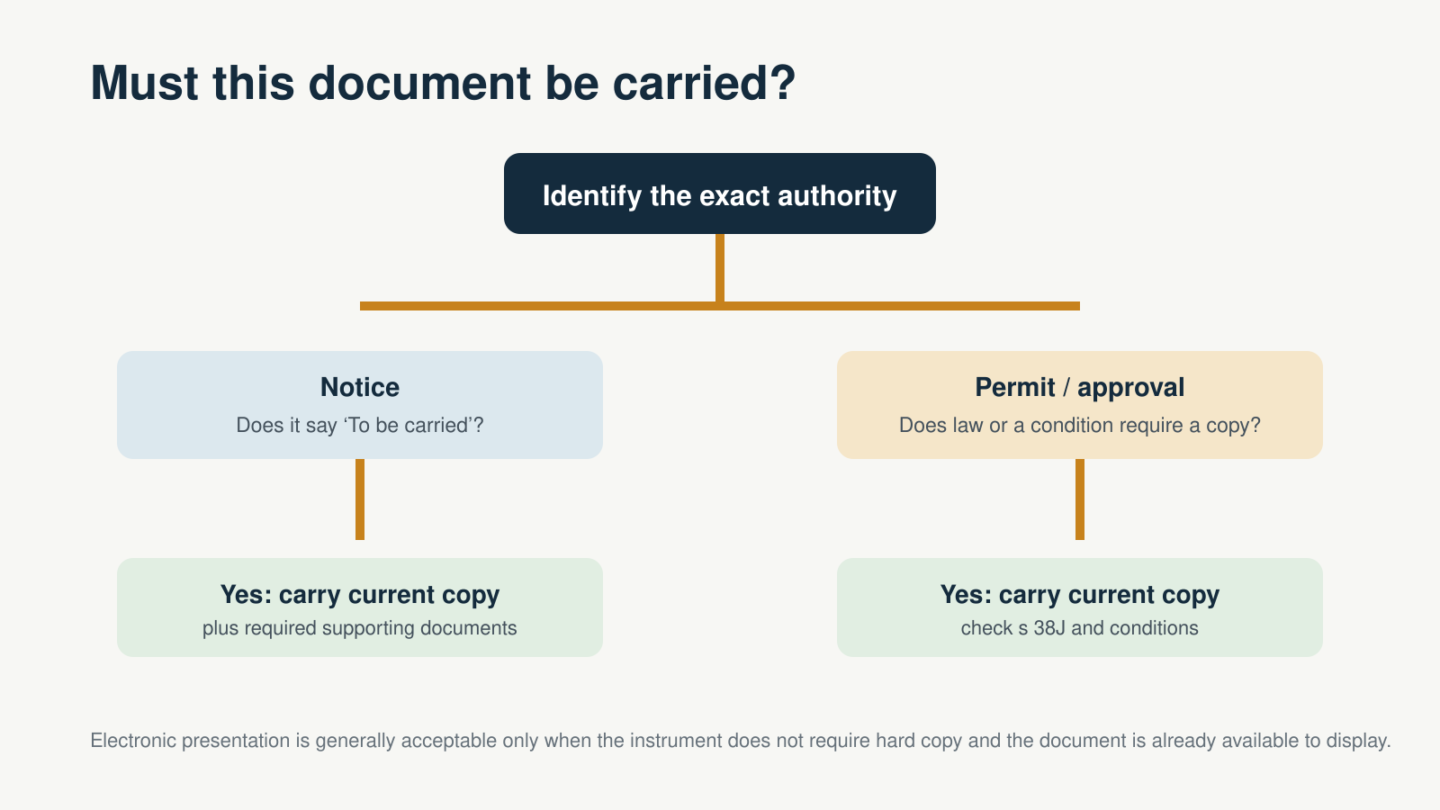
Do not assume every notice must be carried—or that having the notice alone is enough. For a mass or dimension exemption notice or Class 2 authorisation notice, the driver must carry the relevant notice or NHVR information sheet where the notice makes this a condition. For a Class 2 authorisation permit or mass or dimension exemption permit, the driver must keep the permit or a copy in their possession under s 38J of the current Heavy Vehicle (Mass, Dimension and Loading) National Regulation. Other regimes have their own requirements, including work-and-rest or work-diary exemption permits, vehicle-standards exemption permits, PBS Vehicle Approvals, certificates or approvals identified by a notice, state-condition documents and pilot or escort material.
What this means operationally
The carriage obligation remains after the 1 August 2026 reforms. Former separate provisions in HVNL ss 133 and 152 were repealed, but the requirement was relocated to regulation s 38J—not abolished. Documents may generally be shown electronically unless a hard copy is expressly required. The document should already be stored on a device available to the driver, displayed clearly and produced without requiring an officer to enter the vehicle. Downloading it from the internet at an interception is not accepted. A USB alone is insufficient unless the document can be opened and displayed.
Who it applies to
Drivers, operators and relevant parties operating under notices, permits, PBS approvals or other conditional authorities.
Example
A current vehicle-carrier notice may say ‘To be carried: No’, but its network conditions still apply. A vehicle operating under an individual access permit must carry the permit or a copy, including any additional document its conditions require.
Exceptions and traps
Identify the exact notice, permit or approval; check its ‘To be carried’ field and conditions; check referenced schedules and documents; store current copies before departure; and confirm the vehicle, route and dates match.
What changed
Carriage requirements were moved into MDL Regulation s 38J for Class 2 authorisation permits and mass or dimension exemption permits from 1 August 2026.
Previous rule
Former separate HVNL provisions governed the permit-copy requirement.
Legal foundation
HVNL ss 129, 132, 150 and 151; Heavy Vehicle (Mass, Dimension and Loading) National Regulation s 38J; applicable fatigue, vehicle-standards and other regulations.
Sources & primary documents
- www.legislation.qld.gov.au/view/whole/html/inforce/current/sl-2013-0077
- www.legislation.qld.gov.au/view/whole/html/current/act-2012-hvnlq
- www.nhvr.gov.au/safety-accreditation-compliance/on-road-compliance-and-enforcement/carriage-and-presentation-of-documents
- www.nhvr.gov.au/law-policies/notices-and-permit-based-schemes/notices-that-must-be-carried
WWTG verification: Queensland Legislation; NHVR
Frequently asked questions
Must every Gazette notice be carried?
No. Check the notice’s ‘To be carried’ field and operative conditions.
Can documents be kept on a phone or tablet?
Generally yes unless a hard copy is expressly required, provided the document is already stored and can be clearly displayed.
Is an online copy enough?
No. Relying on downloading the document at the interception is not accepted.
Who must provide the documents?
The applicable law, permit or instrument identifies the driver and any relevant parties responsible.
What happens if a required document cannot be produced?
The driver and relevant parties may be unable to show compliance and may face enforcement action.